


High-temperature wire harnesses connect electrical components in extreme heat environments. They use special materials that stay strong even when exposed to temperatures from 150°C to 260°C. These harnesses keep power flowing in hot places where regular wiring would fail.
Companies like Wiringo make these specialized solutions for automotive engines and factory machines. The right materials and design ensure these wire bundles work reliably when surrounded by intense heat.
Get Your Free Sample!
Explore our custom services now. Email us at sales@wiringo.com for more details.
What Is a Wire Harness?
A wire harness bundles multiple wires into one organized unit. It includes electrical wire, cables, connectors, and terminals that transmit power and signals between the components of a system. This bundling makes installation easier and protects the wire from damage.
Characteristics of a High-Temperature Wire Harness
High-temperature wire harnesses offer several key advantages:
- Heat Resistance: Work reliably in high temperature environments from 150°C to 260°C
- Toughness: Handle heat cycles without breaking down
- Special Insulation: Use materials like silicone, PTFE, or fiberglass
- Flame Protection: Resistant to catching fire
- Chemical Resistance: Stand up to oils and harsh chemicals
- Reinforced Construction: Often includes fiberglass braiding for extra protection
These harnesses utilize heat-stable materials, such as braided shields and ceramic fiber insulation, to withstand extremely hot conditions.
Where Are High-Temperature Wiring Harnesses Used?
High-temperature wiring harnesses are crucial in industries where standard wiring would fail under extreme heat conditions.
Robotics
Industrial robots need reliable wiring in harsh environments:
- Control systems in hot manufacturing areas
- Welding robots that work near extreme heat
- Robots near furnaces or ovens
- Systems with high-power motors that generate heat
These specialized harnesses keep automation systems running without electrical failures. Robotic wire harnesses must meet IEC 60204-1 electrical safety standards and RIA/ANSI R15.06 robotic safety requirements for industrial applications involving high temperatures.
Automotive industry
The automotive sector relies on heat-resistant wiring, especially in hot areas:
- Engine compartment wiring with high-temp connectors that can withstand extreme conditions
- Connections near exhaust systems
- Sensor wires for engine controls
- High-temp headlight wiring harness systems for vehicle lighting
Automotive harnesses must meet strict standards, such as ISO 6722, to ensure they last the life of the vehicle.
Agriculture
Farm equipment works in harsh conditions with powerful engines:
- Engine wiring for tractors and harvesters
- Control systems for hydraulic parts
- Sensors for monitoring equipment
- Weather-resistant connections for outdoor use
These durable harnesses keep farm machines running reliably, even in extreme heat and outdoor conditions. Agricultural equipment wire harnesses follow ASABE (American Society of Agricultural and Biological Engineers) standards and ISO 14982 for electromagnetic compatibility in harsh field conditions.
Get Your Free Sample!
Explore our custom services now. Email us at sales@wiringo.com for more details.
What Materials Are Used in High-Temperature Wire Harnesses?
The exceptional performance of high-temperature wire harnesses comes from specialized materials designed to maintain integrity under thermal stress.
Fluoropolymers
| Material Type | Temperature Rating | Key Properties | Primary Applications | Special Notes |
| PTFE (Teflon) | Up to 260°C | • Most heat-resistant• Low-friction• Excellent electrical properties• Chemical resistance | • Industrial controls• Engine compartments | Most widely used high-temp insulator |
| FEP | Up to 200°C | • Chemical resistance• Low friction• Easier to process than PTFE• Superior electrical properties | • Chemical processing• Food equipment• General industrial• Marine electronics | Excellent balance of properties and processability |
| ETFE | Up to 150°C | • Chemical resistance• Abrasion resistance• Radiation resistance• Excellent toughness | • Nuclear• Transport• Chemical environments | Best for radiation exposure environments |
| PFA | Up to 260°C | • Similar to PTFE• Better flow characteristics• Chemical resistance | • Semiconductor• Chemical processing | Premium choice for ultra-pure environments |
| PVDF (Polyvinylidene Fluoride) | ~150 °C rating | •Flame resistance•Chemical stability•Good dielectric strength | •Nuclear systems•Chemical processing | Offers a cost-effective balance of heat tolerance and chemical resistance |
Thermosets & Rubbers
| Material Type | Temperature Rating | Key Properties | Primary Applications | Special Notes |
| Silicone | Up to 200°C | • Maintains flexibility• Good electrical properties• Heat resistant• Very flexible | • Automotive sensors• Appliance wiring• Medical devices• General high-temp wiring | Best flexibility retention at high temps |
| EPDM | Up to 150°C | • Weather resistant• Ozone resistant• Moderate heat tolerance | • Outdoor equipment• Weatherproof connections• General industrial | Excellent outdoor durability |
| Viton | Up to 230°C+ | • Superior chemical resistance• Extreme heat tolerance• Chemical exposure tolerance | • Chemical processing• Fuel systems• Harsh environments• Engine compartments | Premium choice for chemical exposure |
Engineering Plastics
| Material Type | Temperature Rating | Key Properties | Primary Applications | Special Notes |
| PEEK | Up to 250°C | • Strong mechanical properties• Chemical resistance• High performance | • Automotive• Specialized industrial | Highest performance engineering plastic |
| PPS | Up to 200°C | • Excellent chemical stability• Heat stability• Dimensional stability | • Electrical components• Harsh environments | Good balance of properties and cost |
| Nylon Types | Up to 125°C | • Abrasion resistance• Low moisture absorption (Nylon 12)• Good mechanical strength | • Automotive• Industrial• Standard jacketing | Available in multiple grades:• Nylon 6/6 (105°C)• Nylon 11 (125°C)• Nylon 12 (125°C) | |
Nylon serves as an outer jacket for wires with these key properties:
| Nylon Type | Heat Resistance | Key Benefits | Typical Uses |
| Nylon 6/6 | Up to 105°C | Good general-purpose | Standard jacketing |
| Nylon 11 | Up to 125°C | Better heat resistance | Moderate heat applications |
| Nylon 12 | Up to 125°C | Low moisture absorption, abrasion resistance | Automotive, industrial |
Specialty Materials
| Material Type | Temperature Rating | Key Properties | Primary Applications | Special Notes |
| XLPE | Up to 125°C | • Better heat resistance• Mechanical strength• Good electrical properties | • Power cables• Transmission lines• Underground cables | Improved version of standard PE |
| TPV/TPR | 125-160°C | • Rubber-like performance• Easy processing• Flexible | • Flexible connections• Cable jacketing• Wear protection | Combines plastic processing with rubber performance |
| TPE | Moderate to high | • Heat-resistant• Flexible• Good processing | • General industrial• Medical• Food applications | Various grades available |
Protective Coverings
| Material Type | Temperature Rating | Key Properties | Primary Applications | Special Notes |
| Fiberglass | Up to 482°C | • Exceptional heat protection• Cost effective• Non-conductive | • Furnaces• Kilns• Metal processing | Best cost-performance for extreme heat |
| Metal Braiding | Up to 600°C+ | • EMI shielding• Maximum protection• Mechanical strength | • Engine compartments• Furnaces• High-EMI environments | Highest temperature resistance |
High-Temperature vs Low-Temperature Wiring Harnesses
Understanding the key differences between high and low-temperature harnesses helps in selecting the right solution for specific applications.
Materials
High-Temperature Wiring Harness: Made with heat-resistant materials like silicone, Teflon, or fluoroplastics that keep their properties when hot.
Low-Temperature Wiring Harness: Uses materials such as polyethylene or PVC, which perform well in cold conditions but cannot withstand high temperatures.
Operating conditions
High-Temperature Wiring Harness: Built for hot places like engines, industrial machines, or ovens, working reliably from 125°C to 260°C.
Low-Temperature Wiring Harness: Designed for cold environments, such as freezers or arctic settings, to remain flexible in low temperatures.
Durability
High-Temperature Wiring Harness: Resists wear, heat, and chemicals while maintaining its integrity even in high temperatures.
Low-Temperature Wiring Harness: Stays flexible when cold but may fail if exposed to high heat.
Cost
High-Temperature Wiring Harness: Costs more due to the use of special materials and advanced manufacturing processes.
Low-Temperature Wiring Harness: Generally cheaper because it uses simpler materials.
What Are the Benefits of High-Temperature Wire Harnesses?
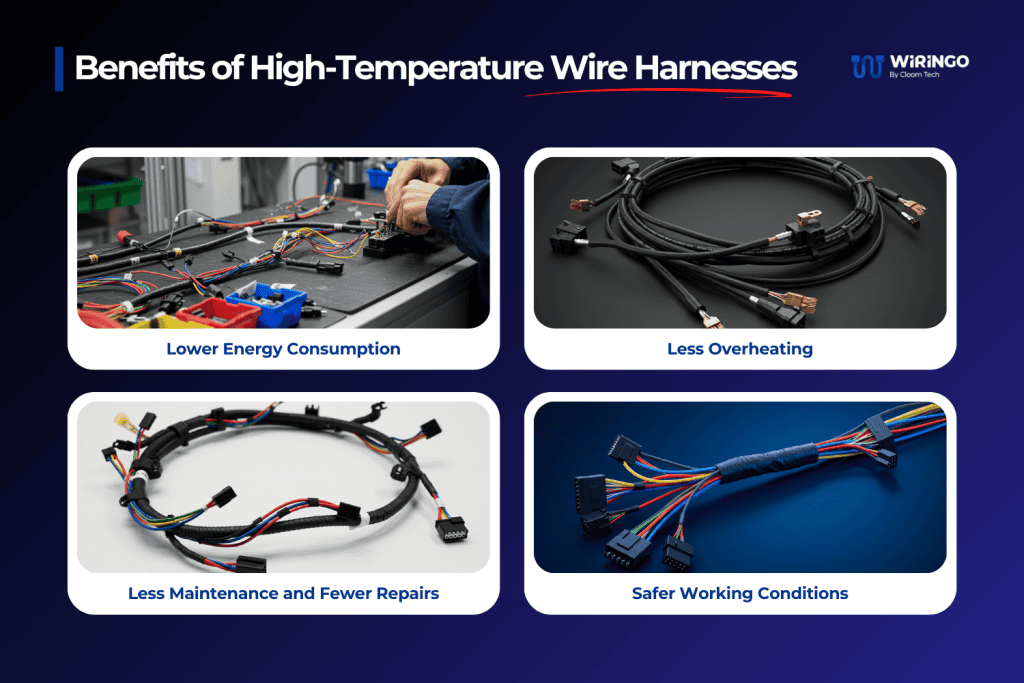
High-temperature wire harnesses offer several key advantages in hot environments.
Lower energy consumption
High-temperature harnesses improve energy efficiency by:
- Reducing electrical leakage even when hot
- Maintaining good conductivity under heat stress
- Delivering power more efficiently
These efficiency gains result in energy savings over the equipment’s lifetime.
Less overheating
These harnesses not only withstand heat but also help prevent it:
- Better insulation reduces heat from electrical resistance
- Improved heat dissipation compared to standard wiring
- Prevention of safety issues caused by overheating
This reduced heat extends the life of connected parts and helps prevent the melting of components.
Less maintenance and fewer repairs
High-temperature wire harnesses reduce service needs:
- Longer time between maintenance
- Fewer emergency fixes from heat failures
- Less downtime from electrical problems
- Lower lifetime maintenance costs
These benefits lead to improved productivity and lower operating costs.
Safer working conditions
When wiring fails from heat, it creates dangers. High-temperature harnesses improve safety by:
- Lowering fire risks
- Preventing electrical shorts
- Eliminating toxic fumes from melting insulation
- Creating more reliable electrical systems
Safety improvements protect both people and equipment.
How to Choose the Right Wiring Harness

Selecting the appropriate wiring harness requires careful evaluation of your specific operating environment and application requirements. Most importantly, supplier verification and third-party test reports play a significant role in choosing the right harness.
Operating temperature
The main factor in choosing a wire harness is how hot it will get:
- Determine the highest temperature in your installation area
- Add extra margin for unexpected heat spikes
- Consider both constant and occasional temperature exposure
- Pick a harness rated specifically for those conditions
Understanding your heat environment ensures reliable performance.
Application needs
Different uses require different harness features:
- Physical stress factors (vibration, bending, rubbing)
- Chemical exposure (oils, fuels, cleaning products)
- Space limits and routing needs
- Electrical requirements (voltage, current)
Your harness should match the specific requirements of your application.
Ability to withstand extreme conditions
Beyond temperature, other factors affect harness performance:
- UV exposure from sunlight
- Moisture and humidity
- Dirt and dust
- Vibration and movement
Choose materials that can handle all environmental challenges.
Tip: Work with wire harness manufacturing experts
Working with experienced wire harness manufacturers ensures you get exactly what you need. They can guide you on material selection, design optimization, and testing.
For best results, partner with experts who understand both technical requirements and industry standards. Their knowledge ensures your harness will work reliably even in the toughest conditions.
Wiringo | The Best High-Temperature Wiring Harness Manufacturer
Wiringo specializes in creating custom high-temperature wire harnesses for demanding environments. Our line of headlight wiring harnesses includes options with protective wrap and tape solutions to shield connections from heat damage. We design and build harnesses that meet your exact needs while handling extreme heat.
Our customized high-temperature wire harnesses cover the following benefits:
- Designs tailored to your specific application
- Quality materials selected for the best performance in high heat
- Thorough testing for temperature resistance
- ISO 9001:2015 certified manufacturing
- Expert support throughout the design process
Wiring harnesses also need proper adhesive tape and heat shrink options for complete installation. Our solutions include plug-and-play connectors for H1, H3, H4, H7, and H11 lighting systems, as well as wire sleeve and split loom wire protection for enhanced cable management.
Don’t risk electrical failures in high-heat environments. Contact Wiringo today to receive a complimentary quote for high-temperature wire harnesses tailored to your specific requirements.
Get Your Free Sample!
Explore our custom services now. Email us at sales@wiringo.com for more details.