


Lean wire harness manufacturing applies a structured production discipline to control variation and eliminate non-value-added activities. Aligning production pace (TAKT time) with customer demand creates a more responsive and efficient assembly process. Early builds expose labor imbalances and material-flow constraints, allowing teams to address bottlenecks before volume scales.
Lead times drop as these controls reduce rework loops and stabilize throughput. As volume increases, standardized operations support scalable production without sacrificing traceability or electrical performance.
Get Your Free Sample!
Explore our custom services now. Email us at sales@wiringo.com for more details.
What Is Lean Wire Harness Manufacturing?
Lean wire harness manufacturing aligns work steps with customer demand rather than batch volume. The approach structures the manufacturing process so each build follows a documented flow with measured timing and controlled handoffs.
Traditional batch builds push volume through staging queues, while lean organizes the production line around pull signals and balanced labor. The shift reduces waiting time and exposes issues earlier within active production processes, rather than after final inspection.
Wire harness assembly suits lean optimization because repeatable tasks allow visible flow control and fast feedback. That visibility supports continuous improvement by showing where variation disrupts output and where process discipline restores predictable performance.
Why Lean Matters In Wire Harness Production
Wire harnesses operate in high-mix, low-volume environments where frequent changes strain production and increase the risk of delays. Without lean manufacturing, a single bottleneck or unexpected disruption can stall flow, increase work in progress, and mask root causes.
Lean addresses these pressures by identifying and eliminating waste drivers that inflate cycle time and inventory. The approach supports minimizing waste across excess inventory, overproduction, waiting, and defects, which directly drives lower costs and steadier output. Reduced material waste also improves material usage consistency while lowering scrap-related variability.
These controls shorten lead times, improve first-pass quality, and protect throughput as demand shifts. Reduced inventory and less scrap, lower carrying expenses, and shrink the environmental impact tied to excess materials and rework.
Get Your Free Sample!
Explore our custom services now. Email us at sales@wiringo.com for more details.
How Lean Principles Reduce Waste In Wire Harness Assembly
Lean principles reduce waste by structuring assembly steps so material, labor and inspection occur only when required.
Controlled sequencing helps minimize excess handling and prevents defects from advancing downstream. Formal waste elimination reduces scrap exposure and shortens correction cycles, delivering measurable cost savings within high-mix harness programs.
The Pillars of Lean Wire Harness Manufacturing in Action
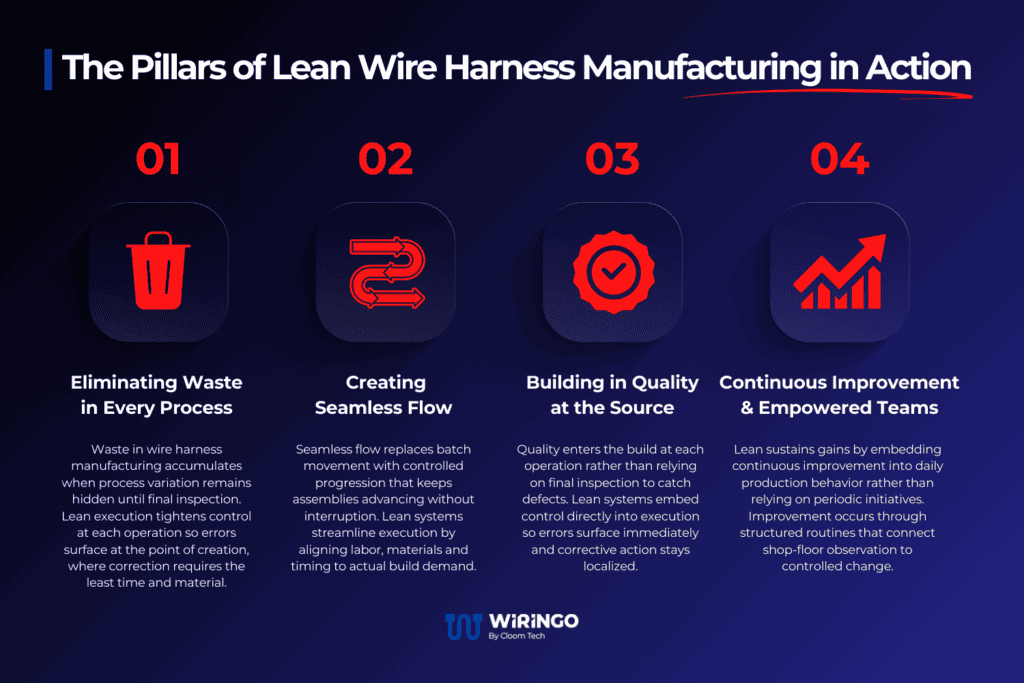
Applying lean theory to wire harness manufacturing requires disciplined structure within complex, high-mix environments. Defined pillars guide production processes toward stability through measured controls and feedback loops.
Each pillar supports process optimization while reinforcing continuous improvement across the production floor. The principles below demonstrate how lean practices create a more efficient and reliable production floor.
Pillar 1: Eliminating Waste in Every Process
Waste in wire harness manufacturing accumulates when process variation remains hidden until final inspection. Lean execution tightens control at each operation so errors surface at the point of creation, where correction requires the least time and material.
- Defects and rework: Torque limits, crimp height measurements, and visual routing references verify acceptance before the harness advances, preventing downstream disassembly.
- Overproduction: Job release is directly linked to tester availability and downstream capacity, which limits the staging of unfinished assemblies between operations.
- Excess motion and handling: Fixture height, board layout, and kit sequencing follow the exact build order, reducing reach variation and secondary handling.
- Waiting: Cycle time matching between cut-strip-crimp and final test keeps assemblies moving without idle accumulation.
Pillar 2: Creating Seamless Flow
Seamless flow replaces batch movement with controlled progression, keeping assemblies advancing without interruption. Lean systems streamline execution by aligning labor, materials, and timing to actual build demand.
- Work cells and single-piece flow: U-shaped cells move each harness through a defined sequence of steps, preventing queue buildup and exposing imbalances immediately.
- Kitting and material staging: Dedicated kits follow the harness through assembly, reducing search time and stabilizing task timing.
- Visual pull control using kanban: Signal cards trigger replenishment only after consumption, maintaining availability while preventing excess stock at the station.
- Load balancing between operations: Cycle times adjust to downstream capacity, so no process advances work faster than the next step can absorb.
Pillar 3: Building in Quality at the Source
Quality is built in at each operation rather than relying on final inspection to catch defects. Lean systems embed control directly into execution so errors surface immediately and corrective action stays localized.
- Standardized work and visual controls: Digital instructions aligned to IPC/WHMA-A-620 define task sequence and acceptance limits, keeping routing and termination consistent across operators.
- In-process testing and poka-yoke: Continuity checks and error-proof fixtures stop advancement when conditions fall outside tolerance, preventing hidden defects from moving forward.
- Automated precision through automation: Cut-strip-crimp equipment applies controlled force and strip length, which reduces variability tied to manual handling.
- End-to-end traceability: Serialized records link components, operators, and test results, creating a complete audit trail that supports compliance and root-cause analysis.
Pillar 4: Continuous Improvement & Empowered Teams
Lean sustains gains by embedding continuous improvement into daily production behavior rather than relying on periodic initiatives. Improvement occurs through structured routines that connect shop-floor observation to controlled change.
- Operator autonomy: Operators document recurring delays or fit issues at the point of use, which feed formal change review rather than informal workarounds.
- Data-driven decisions: Trend analysis of cycle drift and defect recurrence directs focused adjustments that lock in stability before variability spreads.
Which Industries Need Lean Wire Harness Production?
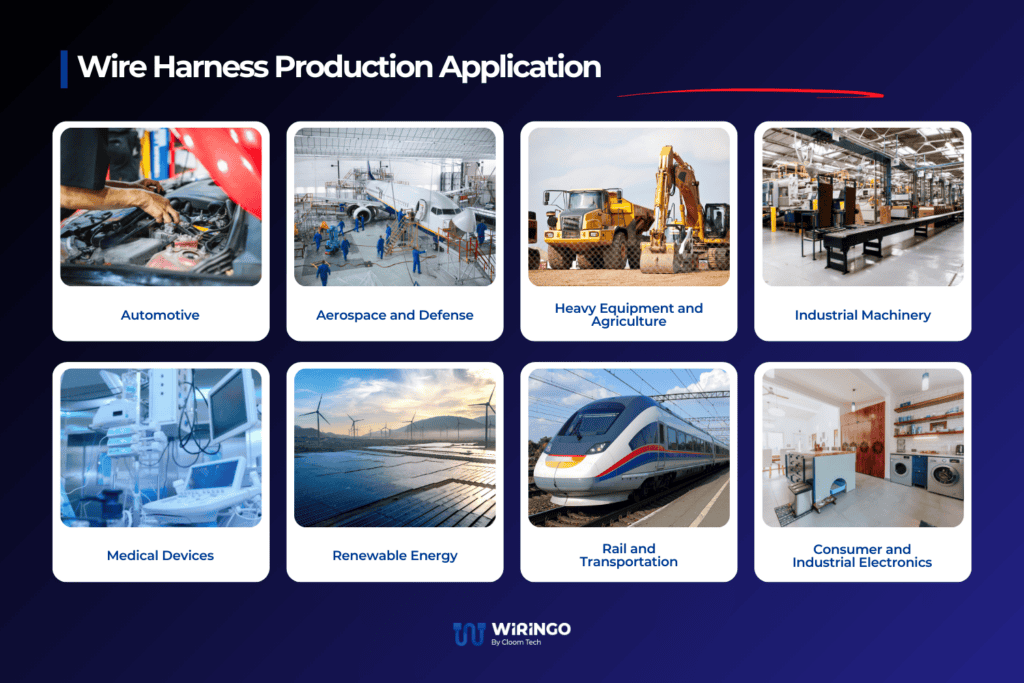
Lean wire harness production is critical for sectors where reliability, scalability, and complexity demand disciplined manufacturing.
- Automotive: High-volume programs with frequent variant changes depend on standardization to control cost, protect quality, and maintain delivery stability across automotive platforms.
- Heavy equipment and agriculture: Large harness assemblies operate in harsh environments, where downtime can cause significant operational losses.
- Industrial machinery: Custom configurations and long service life demand consistent build methods that preserve reliability over extended use.
- Medical devices: Precision assembly and compliance requirements support patient safety within tightly controlled production systems.
- Renewable energy: Wind and solar installations rely on durable wiring to sustain long-term reliability under environmental stress.
- Rail and transportation: Vibration exposure and certification requirements demand repeatable processes over long equipment lifecycles.
- Electronics Manufacturing: High-mix electronics production supporting complex electronic systems benefits from lean flow that sustains Industry-leading quality while meeting rapid demand cycles.
When To Switch To Lean Wire Harness Production
Lean wire harness production becomes necessary when existing build methods strain cost control, delivery performance, or quality targets. Clear operational signals show when traditional approaches no longer support scalable, cost-effective output.
1. Growth and Scaling Challenges:
- Repeat builds or rising volumes: Sustained demand exposes inefficiencies that increase operational costs and limit consistency.
- Scaling programs: Expanding product lines requires a structured flow to improve throughput without adding proportional labor.
- High-mix complexity: Long cycle times in configurable harnesses require flow-based execution.
2. Quality and Delivery Pressure:
- Strict quality requirements: Zero-defect expectations from OEMs demand tighter control to prevent elevated scrap rates.
- Compressed delivery schedules: Short lead-time pressure benefits from predictable cycle control rather than batch buffering.
3. Cost and Efficiency Issues:
- Cost pressure on margins: High labor or material expense signals the need for more disciplined production economics.
- Excess waste or inventory: Visible rework and stock accumulation indicate misaligned process timing.
- Unit cost sensitivity: Programs where per-unit cost drives profitability gain a measurable advantage from lean deployment.
Lean Manufacturing As A Foundation For Reliable Wire Harness Production
Lean manufacturing provides the operational structure needed to maintain pace without sacrificing build integrity. Defined methods reduce variability and support consistent execution across wire harness programs with shifting demand.
When lean principles guide daily operations, production gains durability over time rather than short-term efficiency alone. That stability allows manufacturers to sustain output quality as volumes change and complexity increases.
How Wiringo Applies Lean Principles To Wire Harness Manufacturing
At Wiringo, we embed lean principles directly into our production DNA, from initial build planning to final verification. Our defined controls manage material flow, task sequencing, and inspection timing to ensure every harness advances only after meeting documented requirements.
This operating model connects engineering intent with shop-floor execution, empowering our teams to standardize processes, expose constraints instantly, and deliver consistent, high-quality wire harnesses for every customer.
Contact Wiringo about lean wire harness manufacturing solutions designed for efficiency and consistency.
Get Your Free Sample!
Explore our custom services now. Email us at sales@wiringo.com for more details.