

Industrial control components form the operational core of automated systems across manufacturing and infrastructure. Within a panel, industrial control panel components coordinate power distribution, signal processing, circuit protection, and fault isolation to support predictable operation under defined loads.
Control panel reliability depends on the correct selection of components, physical layout, wiring practices, and compliance with applicable standards. Each device performs a specific role while interacting through schematics and terminal assignments. Proper coordination limits thermal stress and simplifies maintenance during the panel lifecycle.
This guide explains the essential elements used in industrial control panels and shows how they function together during design and assembly.
Get Your Free Sample!
Explore our custom services now. Email us at sales@wiringo.com for more details.
How Industrial Control Components Automate Manufacturing Operations
Industrial control relies on precisely specified control components to translate electrical signals into mechanical or logical action. These elements include sensing devices, switching hardware, and programmable controllers that govern how industrial processes respond to changing conditions.
Within panel assemblies, industrial automation hardware executes logic sequences, manages power flow, and regulates motion across connected assets. This structure allows automation control to coordinate control machinery with defined timing and safety interlocks during continuous operation.
When integrated correctly, each device operates as part of a unified control system rather than a standalone element. This alignment enables industrial machinery to perform repeatable tasks at scale, supporting stable throughput and predictable performance across automated production environments.
The Core Component Systems Of Industrial Control Panels
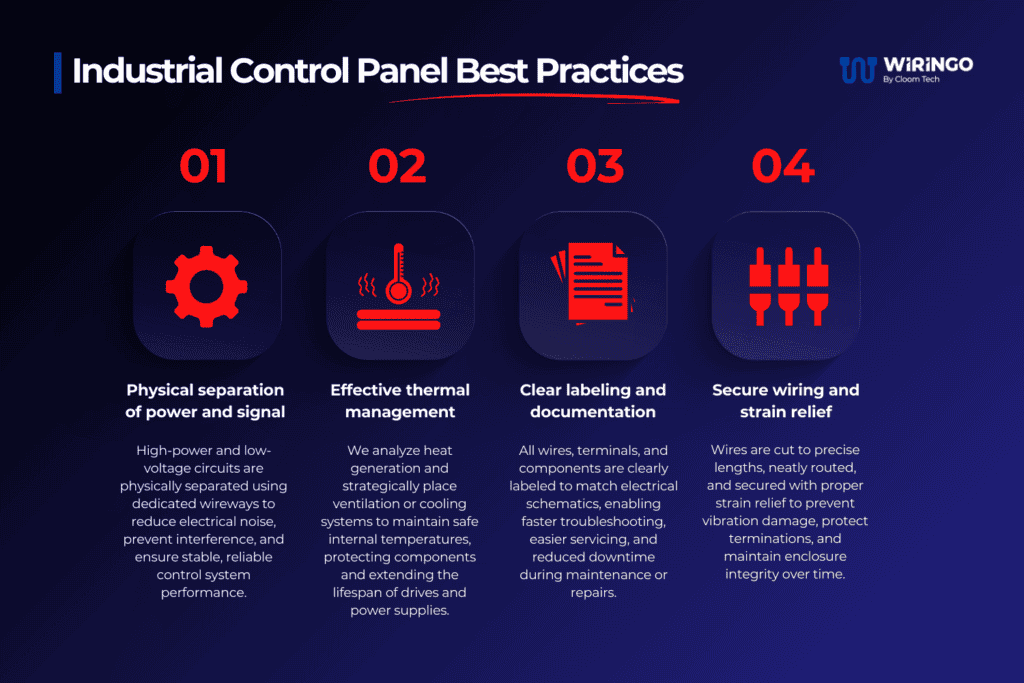
Power Management And Conversion Components
Power management and conversion components govern how electrical power enters, changes form, and moves through an industrial control panel. Proper design at this point limits electrical stress and maintains predictable performance during sustained operation.
- An industrial control panel transformer adjusts the incoming voltage to levels suitable for internal control circuits, thereby isolating sensitive devices from supply variations.
- Power supplies convert conditioned input into a regulated output, while power distribution components deliver energy to each circuit through controlled load paths and ensure continuity.
Circuit Protection And Isolation Devices
Circuit protection and isolation devices control how energy behaves inside a panel when current exceeds safe operating limits. These devices limit damage, contain fault energy, and support safe intervention during abnormal operating conditions.
- A circuit breaker monitors current flow using defined time current curves and trips through thermal or magnetic mechanisms when overload or short conditions create excess electrical stress.
- A fuse interrupts severe electrical faults by melting a calibrated element when current exceeds its rated threshold, permanently opening the circuit to protect downstream components.
- A disconnect switch provides mechanical isolation from incoming power, allowing technicians to de-energize equipment fully and maintain protection against electrical exposure during service or inspection.
Control And Logic Components
Control and logic components govern how automated systems interpret signals and execute controlled actions across industrial equipment. These elements connect field inputs to deliberate outputs, establishing predictable behavior under defined operating conditions.
- Programmable logic controller: Executes programmable logic by continuously evaluating input states and issuing output commands based on programmed control sequences, while maintaining stable operation under vibration, electrical noise, and temperature variation.
- Relay: Uses a low-power control signal to actuate a higher-current circuit while maintaining electrical isolation, reducing the risk of load-side faults affecting upstream control electronics.
- Contactor: Switches high-current loads, such as motors or heaters, via electromechanical actuation, supporting repeated switching cycles at rated current without premature contact wear.
- Control devices: Enable operator interaction and system visibility at the supervisory level, with an industrial computer commonly serving as the human-machine interface for monitoring status and issuing commands without interrupting real-time control.
Motor Control Components
Motor control components manage how a motor starts, operates, and responds to changing load conditions within industrial systems. These elements regulate power delivery, protect equipment, and support consistent motor control across varying operating demands.
- Motor starters: A motor starter combines switching and protection functions to manage electric motor startup under controlled conditions. This assembly limits inrush current while coordinating protective response during abnormal operation.
- Overload relays: These relays monitor current draw and interrupt power when an overload condition threatens motor windings. This protection prevents overheating caused by sustained overcurrent, not short-circuit faults.
- Motor drives: Variable frequency drives regulate voltage and frequency to deliver precise speed control across operating ranges. Drive technologies also support torque regulation, controlled acceleration, deceleration profiles, and process synchronization.
- Safety components: Safety devices enable controlled shutdown under hazardous conditions or during unexpected events. These systems include interlocks, safety relays, emergency stop circuits, and monitoring interfaces that integrate with the motor control system.
Connectivity And Termination Components
Connectivity and termination components support reliable power and signal transfer within industrial enclosures. These elements organize wiring, protect electrical wires, and maintain consistent connections that support long-term system performance.
- Terminal blocks: Terminal blocks provide organized connection points for power and signal distribution, supporting secure terminations and clear circuit identification. Wiringo sources connectors and terminal hardware that meet specified electrical and environmental ratings.
- Wiring ducts: These route and protect conductors within the enclosure while supporting airflow and service access. Proper duct layout maintains bend radius control and separation between power and signal paths.
- Industrial Ethernet switches: These switches enable structured communication between controllers, operator interfaces, drives, and external systems while preserving signal integrity. Wiringo sources compatible connectors and cabling to support reliable network termination.
- The enclosure: The enclosure protects internal connections through appropriate NEMA or Ingress Protection (IP) ratings matched to environmental exposure. Proper enclosure selection supports long-term reliability by shielding termination points from external conditions.
Clear wiring practices support traceability and inspection by keeping electrical wires labeled, routed, and terminated according to documented requirements. Wiringo applies sourced connectors and marked conductors so each connection point remains identifiable and reliable throughout service life.
How Power Flows Through Control Panel Component Systems
Power flow within a control panel depends on coordinated industrial control components that manage voltage, protect each circuit and direct electrical current with predictable results. Each component contributes to controlled electrical flow from the entry point to the load.
- Power entry and distribution: Incoming line voltage enters through a main disconnect, passes through transformation and conversion stages, then branches into protected circuits that regulate downstream electrical current.
- Sensing and decision-making: Sensors transmit electrical signals to the controller, which evaluates conditions and determines whether a downstream action should occur based on programmed logic.
- Command and execution: The controller issues a low-voltage command to actuate switching devices, allowing controlled electrical flow to connected electrical loads without exposing logic circuits to line power.
- Action and monitoring: Power conversion equipment drives the load, while feedback data is returned via communication paths, enabling operators to monitor status and performance within the control panel system.
Get Your Free Sample!
Explore our custom services now. Email us at sales@wiringo.com for more details.
Ul 508a, NEC and IEC Compliance Requirements For Panel Components
Compliance defines how you design and document an electrical control panel built for regulated markets. Standards guide how industrial control components and each electrical component fit the application, environment, and destination.
These requirements clarify how electrical devices perform within approved construction methods. Clear alignment at this stage supports predictable approvals and market acceptance.
- UL 508A: Defines requirements for component selection, wiring methods, and Short-Circuit Current Ratings (SCCR) for panels intended for North America.
- National Electrical Code (NEC): Establishes installation rules that determine how panels connect to power, grounding, and field wiring.
- International Electrotechnical Commission (IEC): Specifies performance and safety criteria for equipment intended for international use.
- NFPA 79: The Electrical Standard for Industrial Machinery, this regulates electrical safety by focusing on operator protection against electrical and fire hazards.
Industries that Rely on Industrial Control Components
Industrial control components are foundational to modern industrial equipment, supporting consistent operation across regulated and high-demand sectors. These systems coordinate power, logic, and feedback to ensure reliability in demanding environments where uptime and safety are critical.
- Manufacturing and automotive: Supports automated production lines, coordinated machine control and repeatable assembly sequences.
- Food and beverage processing: Maintains sanitary operations, controlled packaging and compliance within washdown-rated facilities.
- Pharmaceutical and medical manufacturing: Enables controlled production conditions that protect product integrity and regulatory validation.
- Oil, gas, and energy: Provides power distribution, system monitoring, and dependable performance in harsh or remote locations.
- Pulp, paper, and heavy industrial operations: Drives large-scale automation that reduces waste while improving throughput.
Best Practices In Panel Design And Layout
A well-designed layout supports reliability and long-term serviceability. Panel design choices influence signal integrity, thermal performance, and maintenance efficiency. Original equipment manufacturers (OEMs) should evaluate ratings, interfaces, and serviceability early to achieve consistent builds, reduce rework, and support traceable quality as panels scale.
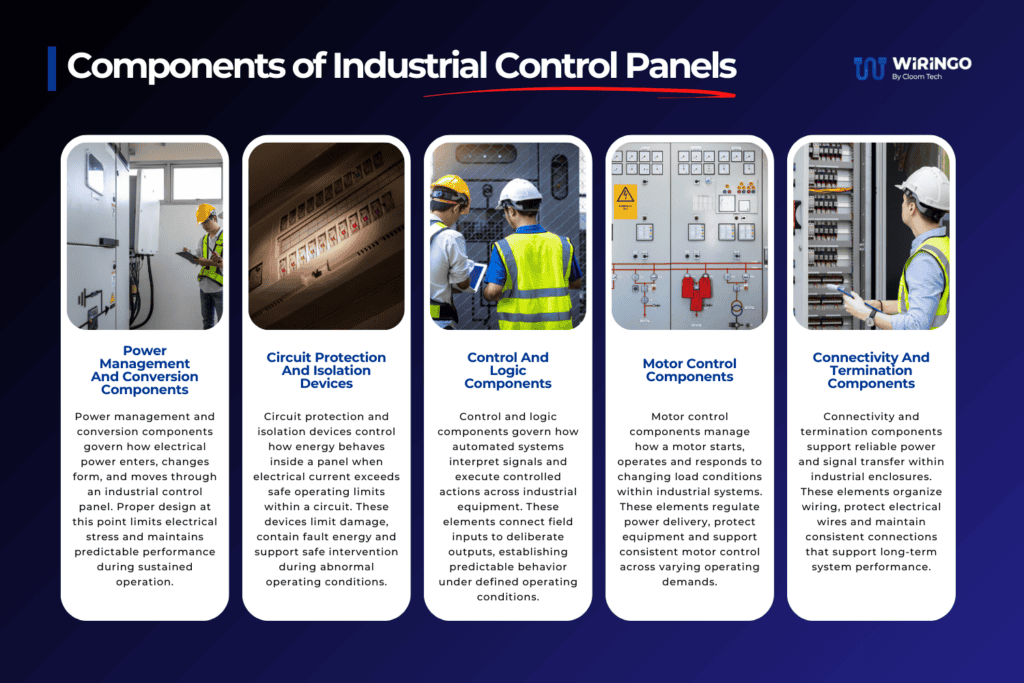
- Physical separation of power and signal: High-voltage wiring can introduce electrical noise into low-voltage control circuits, which leads to faults or unstable behavior.
Wiringo in practice: Our engineers separate high-power devices such as variable frequency drives from sensitive controls such as programmable logic controllers, using dedicated wireways to limit electromagnetic interference at its source.
- Effective thermal management: Drives and power supplies generate heat that shortens component life when left unmanaged.
Wiringo in practice: We perform thermal analysis and position ventilation, fans, or cooling systems to keep internal temperatures within each component’s rated operating range.
- Clear labeling and documentation: Unmarked conductors slow diagnostics and increase downtime during service. Clear wiring practices support traceability and inspection by keeping conductors labeled, routed, and terminated in accordance with documented requirements.
Wiringo in practice: Every wire, terminal and component receives a clear identifier that matches the provided electrical schematics, which allows technicians to isolate issues quickly.
- Secure wiring and strain relief: Poorly supported conductors fail under vibration and complicate maintenance.
Wiringo in practice: We cut wires to precise lengths, route them through organized ducts, and apply proper cable glands and strain relief to protect terminations and preserve enclosure seals.
Where Design Meets Craftsmanship: Achieving Long-Term Reliability
A high-performance industrial control panel results from a holistic approach that pairs quality components with disciplined execution.
Design intent establishes requirements, while manufacturing practices determine how those requirements perform under real operating conditions. Long-term reliability depends on how closely the finished build reflects the original design.
A strong design can fail in the field when workmanship falls short. Experienced manufacturing teams close that gap through precise wire routing, verified torque application, documented grounding methods, and consistent assembly control. This execution turns a sound layout into a field-proven system that supports stable operation throughout its service life.
While Wiringo specializes in manufacturing, not design, our process includes a thorough review of submitted drawings. We provide practical feedback on constructability, compliance alignment, and potential risks to ensure the final build achieves the original design’s intent and performs reliably in the field.
Build Unshakeable Control Systems With Wiringo
Wiringo builds control systems that perform under real operating demands through disciplined manufacturing and proven processes.
Our work integrates panel assembly with custom cable assembly to support signal integrity and mechanical durability across demanding applications. This approach supports consistent performance from installation through long-term operation.
Your systems benefit from wire harness assembly produced with controlled methods, documented workmanship, and verified quality checks. We focus on execution that matches your specifications and supports compliance across regulated environments.
Contact us to discuss your control system requirements and start a build that meets your specifications.
Get Your Free Sample!
Explore our custom services now. Email us at sales@wiringo.com for more details.