


UL, or Underwriters Laboratories, sets safety standards and verifies that products comply with them. In UL-certified assemblies, traceability begins when wire and cable are received at the manufacturing facility and continues through every stage of the build process. This documented trail allows inspectors to verify that the materials used match the approved specifications required for UL compliance.
UL maintains control through follow-up services, where field reps review construction details, labels, and records. Manufacturers must keep documentation that tracks each material from receipt to shipment, along with labels that enable quick verification.
This system creates a direct link between incoming parts and finished assemblies, helping the supply chain prevent non-compliant materials and strengthening global safety for manufacturers who need reliable, audit-ready wiring harnesses. We cover what UL Traceability is, how it applies to cable assemblies, and how to check it on your floor.
Get Your Free Sample!
Explore our custom services now. Email us at sales@wiringo.com for more details.
What UL Traceability Really Means for Cable Assemblies
UL defines the constructions and standards used to evaluate materials and components, while traceability links every incoming part and process step back to those approved requirements. This connection demonstrates how wiring, connectors, and protective elements align with the construction requirements for UL-certified end products.
Auditors verify that each UL Mark matches the approved file and that the documented path remains intact through the supply chain. This structure lowers the risk of mix-ups, keeps non-compliant material out of production, and helps teams maintain the intended construction for every wire harness.
By preserving this link at each stage, manufacturers meet regulatory expectations, strengthen wiring harness traceability, and keep the supply chain ready for field verification.
The UL Programs You’ll Use (Cable & Harness)
UL runs several programs for cables and harnesses, but only a handful shape day-to-day sourcing, labeling, and inspection requirements. These include:
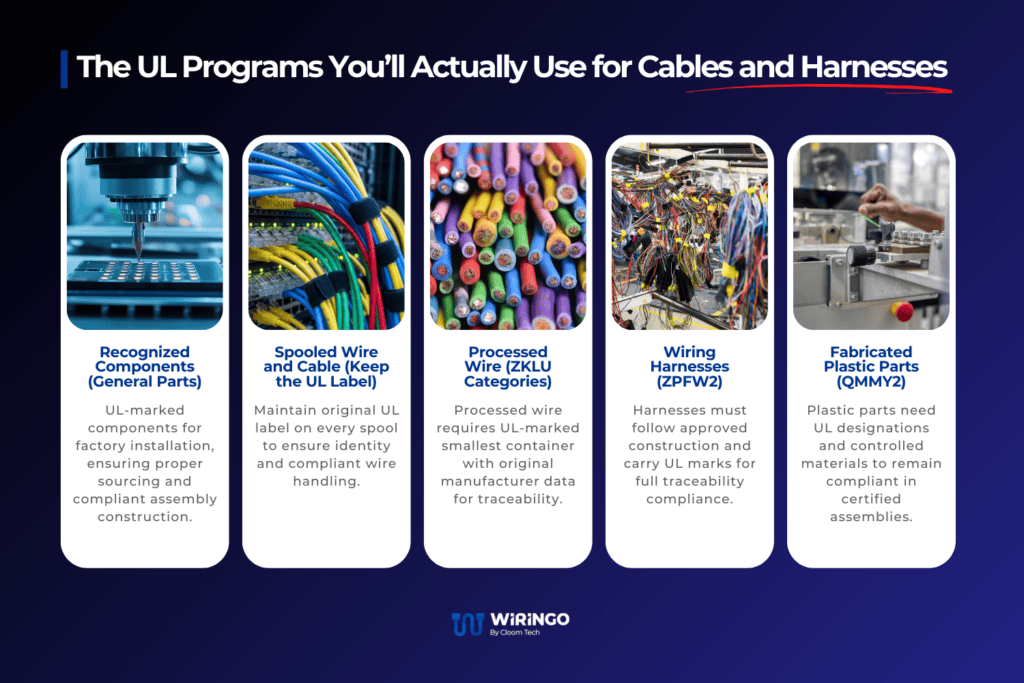
Recognized Components (General Parts)
Recognized components carry the UL Recognized Component Mark along with the company ID and model or catalog number. These parts are intended for factory installation inside assemblies, such as hook up wire and connectors.
Listed products differ because they’re complete units evaluated for an intended use environment. This structure supports proper sourcing requirements and helps ensure that harness designs align with the evaluated constructions.
Spooled Wire and Cable (The UL Label)
Surface printing alone doesn’t meet UL requirements. Keep the original UL Mark or label with the spool, attach the tag to the reel, and request tagged spools from each supplier. Spools without proper labels should be rejected to maintain identity throughout all wire and cable handling steps.
Processed Wire (ZKLU Categories)
When wire is cut, stripped, tinned, crimped, or respooled, the smallest container or tag should carry the UL Mark. The processor tag should include the original manufacturer data so inspectors can verify that every processing step supports the traceability program.
Wiring Harnesses (ZPFW2)
Harnesses assembled away from the final factory and shipped as components should follow the construction in the harness diagram or spec.
Apply the UL Recognized Component Mark on the smallest bundle or container and maintain records needed for the wiring harness traceability program during follow up visits. This structure supports UL wiring verification for any harness manufacturer working within the supply chain.
Fabricated Plastic Parts (QMMY2)
Molded or encapsulated parts should show the UL designation, molder name, factory location, part ID, date, and material grade or an approved code. Manage any regrind or additive use according to the specification so parts remain compliant and suitable for use in UL-certified assemblies.
A Quick Note On UL Cable Selection
Match cable rating to voltage, temperature, and flame performance.
- UL 1061 uses a thinner insulation profile for 300V systems.
- UL 1569 supports 300V and higher-temperature performance.
- UL 1015 supports 600V with a heavier insulation profile.
How To Implement Traceability on Your Floor (5-Step Checklist)
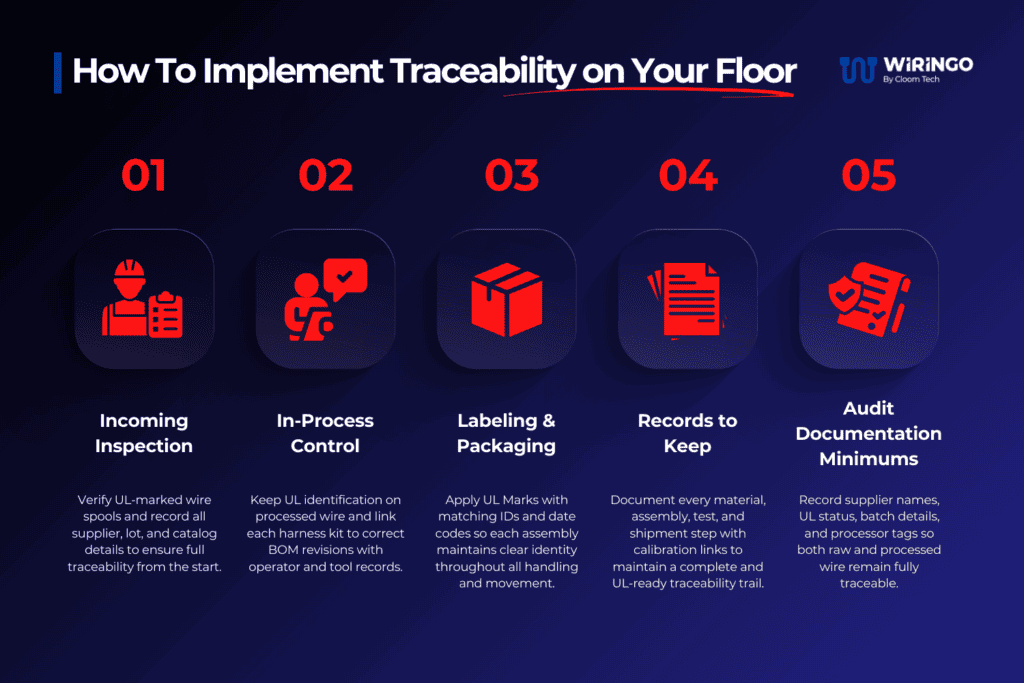
Implementing UL traceability for cable assemblies on the production floor depends on consistent controls that connect incoming parts, processing steps, and final units to the evaluated constructions recorded in applicable UL files.
These actions support traceability, help teams maintain wiring accuracy, and keep each step aligned with the expectations UL checks across the supply chain.
1. Incoming Inspection
Verify that every wire spool has the UL Mark or a valid UL certification identification label, and set aside any spool without proper identity. Record each supplier, lot information, catalog number, and UL control details at receipt so the traceability program can follow incoming wire and cable from the start.
2. In-Process Control
Processed wire should keep its UL certification identification or label on the smallest container and carry the original manufacturer information on the processor tag. For wire harness builds, link each kit to the correct diagram or BOM revision and retain operator records, tool data and dates so wiring harness traceability stays intact during follow up checks.
3. Labeling & Packaging
Apply the UL Recognized Component Mark on the smallest bundle or container for each assembly and include date codes and part IDs that match the traveler or paperwork. These steps help cable assemblies maintain identity as they move across the entire supply chain and prevent broken trace paths.
4. Records To Keep, Ready for UL
Track each step from materials and components through storage, issue, assembly, test and shipment so auditors can follow the documented flow. Keep calibration records tied to test results, and retain plastic material details when required, as these directly support traceability for UL review.
5. What To Document for an Audit (At Minimum)
Document materials and components with the supplier name, model or catalog number, UL status, lot or batch information, and a copy or transcription of the UL Mark. For processed wire, retain the processor tag with transferred original tag data so both stages remain within the traceability program.
For harness builds, keep the diagram or spec revision, construction elements, smallest bundle marking, and test results linked to serial and date. And for molded parts, record molder location, date, part ID, and material grade so these remain valid as components used in UL certified assemblies.
Get Your Free Sample!
Explore our custom services now. Email us at sales@wiringo.com for more details.
Common Pitfalls (And Easy Ways To Avoid Them)
Many UL compliance issues arise when teams overlook how the traceability program links components, markings, and records to evaluated constructions.
Gaps appear when parts fall outside UL requirements, labels go missing, or documentation no longer matches the current standard. Closing these gaps keeps UL-certified wiring harness manufacturers aligned with traceability expectations.
Using Components Without A Proper UL Rating
Selecting wire, terminals, or connectors approved for a different category breaks the trace path and blocks verification. Confirm each category assignment and make sure the intended use fits the listed scope to keep identification reliable.
Losing Traceability During Wire Processing
Traceability fails when labels are removed during stripping or respooling. Preserve identity by securing the UL Mark or tag to the reel before processing and recording each cut length so it ties back to the original spool.
Not Following Component Manuals or Power-Supply Class Requirements
When installers overlook details in UL guide cards or ignore Class 2 rules, the build can fall outside the evaluated construction. Review circuit protection, wire gauge and isolation against published data to maintain compliance.
Improper Documentation or Outdated References
Relying on old tables or outdated Follow Up Service details creates mismatched categories and missing control numbers. Reference the current UL directory and maintain revision control that reflects the latest standard.
Missing Or Inconsistent Markings On Assemblies
Harnesses shipped without the UL Recognized Component Mark on the smallest bundle or container can’t be verified. Apply the correct mark and assembler code and keep inspection records that support the traceability path.
Best Practices To Stay Compliant with UL Traceability
Staying compliant with UL requirements depends on clear traceability that links every part and process to its evaluated construction. These practices protect material identity, maintain accurate documentation, and reduce the risk of gaps that could disrupt verification.
UL defines traceability as the ability to follow materials from receipt through use. The steps below clarify how to apply that control in daily production.
- Confirm that every supplier provides parts that meet UL requirements and retains supporting records showing how each part fits the evaluated construction.
- Verify the correct UL category codes during design review so parts, intended use, and documentation stay aligned.
- Train production staff to retain labels, record each step accurately, and keep identity tied to the source information.
- Use internal audits to confirm that all records and labels stay consistent with the evaluated construction and the flow of materials through the build.
When Do”Split Inspection”Split Inspection and”Document Audit” Apply?
UL uses these two review paths when components or assemblies originate outside the primary production site.
Each method supports identity control for parts that may include appliance wiring material or items supplied by wire and cable distributors, cable distributors, and processors, and both help maintain the trace path until the full program is in place.
Split Inspection
Split inspection covers off-site locations that aren’t managed under another UL program. UL reviews the site so the receiving factory can accept components without repeating inspections and checks records and labels to confirm they link back to evaluated data.
Document Audit
A document audit supports short-term acceptance while a facility installs the correct UL program. UL reviews the submitted records to confirm that they match the evaluated construction and support the trace path, but this option is not intended for long-term use.
UL Traceability for Cable Assemblies | FAQ
Is surface-printed wire sufficient for UL traceability?
No, surface printing doesn’t meet the requirements for UL listings. Keep the original UL spool label with the reel so inspectors can during field review.
What mark should a shipped wiring harness carry?
A harness should display the UL Recognized Component Mark on the smallest bundle or unit container. This helps the receiver confirm identity and supports the safety standards applied to assemblies used by any original equipment manufacturer.
What traceability is required when cutting, stripping, or tinning wire?
Retain the processed wire label and keep records to trace the material back to the original spool. This protects identity and supports the trace path needed to reduce liability and risk during inspection.
Can we rely on a document audit forever?
No. A document audit only supports short-term acceptance. A facility must transition to the correct program so UL can verify identity, labeling, and construction with the consistency expected under UL listings.
How Wiringo Approaches UL Traceability
Wiringo supports UL traceability for cable assemblies by linking ISO 9001 and IATF 16949 procedures to receiving, traveler controls, and device history records. These steps connect each part to the evaluated construction used for certified end products as part of the verification path and help ensure supply chain integrity from intake through shipment.
Barcoded labels carry UL attributes through kitting, assembly, test, and pack so identity stays clear at every stage. For build to print and design to spec harnesses, UL requirements appear in drawings, BOMs and supplier terms so each part fits the intended construction.
Teams retain labels, keep processor tags clean and map each component to the UL Follow Up Services description so audits move without delays. UL solutions help define the structure that guides these controls, and Wiringo applies those steps to keep each build ready for review.
Contact Wiringo to build UL-traceable cable assemblies that are easy to inspect and ready for certification.
Get Your Free Sample!
Explore our custom services now. Email us at sales@wiringo.com for more details.