


A custom engine wiring harness is the electrical backbone of the powertrain, linking the ECU to critical sensors, actuators, ignition, starting and charging systems.
Wiringo builds engine harnesses to your exact layout, with tight, well-sealed, serviceable looms and quick RFQs backed by direct engineering support.
Get Your Free Sample!
Explore our custom services now. Email us at sales@wiringo.com for more details.
What Is a Custom Engine Wiring Harness?
A typical engine harness interconnects the ECU, engine-bay sensors (temperature, pressure, position), fuel injectors, ignition coils, throttle body, EGR/actuators, alternator, and starter.
It’s mounted along and beneath the engine exterior, where heat and vibration dominate, with incidental exposure to oil, fuel, coolant, and spray. We design to prevent vibration-induced intermittence, conductor fatigue at tight bends, moisture ingress at exposed interfaces, and thermal aging.

How Does the Engine Wiring Harness Work?
A custom engine wiring harness works as the nervous system of your engine.
It carries power and signals between the ECU, sensors, actuators, ignition, starter, and charging system. This keeps every component in sync so the engine runs as intended.
Materials and construction
Wiringo manufactures each harness around the duty cycle, sizing conductors correctly, and selecting connector systems that match the environment and requirements.
The design uses jacketing, tapes or sleeves, heat shields, and molded transitions to handle temperatures from roughly -40 °C to 150 °C, with materials that tolerate oil, fuel, coolant, cleaners, and UV exposure.
Extra protection goes only where it truly pays off, such as at edges, clamps, and pass-throughs, so the loom stays compact and light while still durable.
In hot zones, self-extinguishing insulation, fiberglass or molded shields, and adhesive-lined heat-shrink provide thermal defense and strain relief. Overmolded or booted backshells reinforce high-stress transitions, and when size, weight, and cost compete, durability and service life take priority.
Connectors and sealing
We work with the connector families your OEM specifies and design sealing from the start.
Grommets, boots, cavity plugs, and end caps seal interfaces, while adhesive-lined heat-shrink closes any gaps where no dedicated hardware exists.
Drawings define keying and orientation clearly to support correct first-time mating and easy tool access for technicians.
Installation and service
Our designers lay out each loom for clean installation and straightforward service.
The team orients connectors for access and places labels where they remain readable after installation.
Every branch includes a service loop so technicians can remove and refit parts without stressing the last centimeters of conductor.
At handover, Wiringo supplies clear installation documentation with pin maps, routing diagrams, and visual examples so the maintenance team can install, troubleshoot, and replace engine harnesses quickly and confidently.
Custom Engine Wiring Harness: Standards and Compliance
Wiringo builds every custom engine wiring harness inside ISO 9001:2015 and IATF 16949:2016 quality systems to ensure reliability, security, durability, and optimal performance.
Each design follows RoHS and REACH requirements, and we keep full compliance documentation ready for your audits.
We also design and manufacture UL-compliant harnesses for programs that require formal third-party safety certification.

Get Your Free Sample!
Explore our custom services now. Email us at sales@wiringo.com for more details.
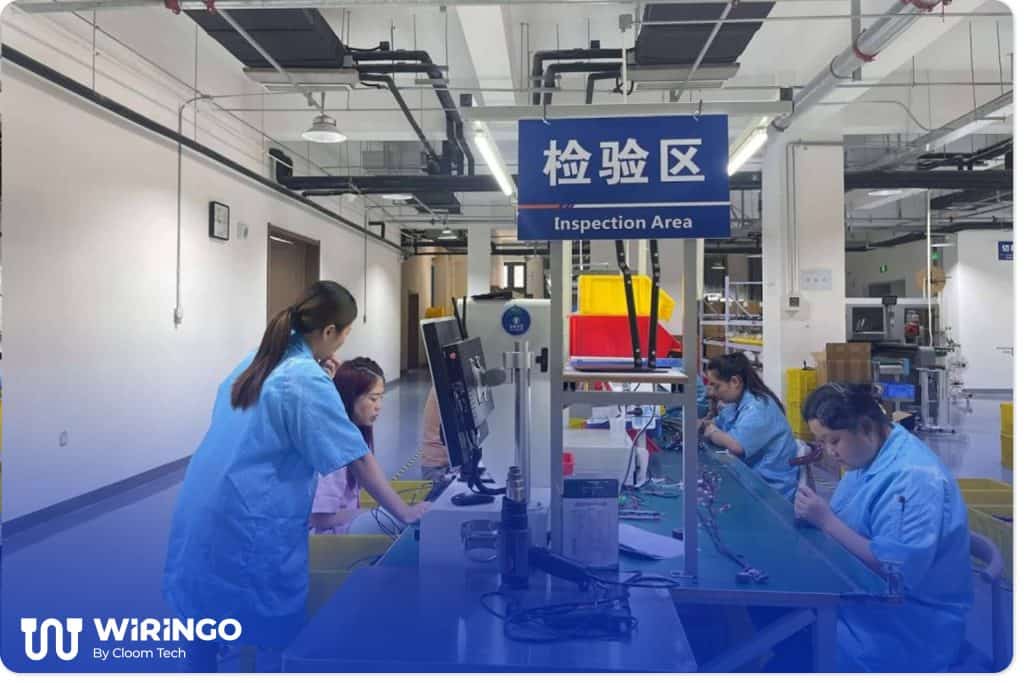
How does Wiringo Inspect and Test Custom Engine Wiring Harness?
Our technicians inspect and test every engine wiring harness before shipment:
- Run 100% electrical tests for continuity, isolation, resistance, insulation integrity, and short circuits
- Confirm each connector locks correctly and stays attached
They then complete application-specific checks:
- Perform a detailed visual inspection for correct parts, terminal seating, seal placement, strain relief, coverings, and labeling
- Add airtightness checks at specified interfaces on sealed designs
- Run heat and moisture or elevated-temperature soak tests for hot-zone applications to confirm materials and seals hold up in your environment
We log all measurements and inspection results and include them in the inspection report so your team can see exactly how each harness performs.
Engine Wiring Harness Failure: Common Problems and Maintenance Tips
A damaged harness does more than hurt performance. It creates a safety risk when the engine stalls or refuses to start at the wrong time. If you ignore broken insulation or corrosion, it will increase the chance of short circuits and, in extreme cases, fire. Fix or replace suspect harnesses early, and you avoid higher repair costs and unplanned downtime.
Common problems and symptoms
A faulty engine wiring harness quickly shows up in how the engine behaves. Typical warning signs include:
- Check Engine Light behaves oddly because the control system receives the wrong signal.
- Hard or no start when power or signal drops on critical circuits.
- Unstable engine performance with stalling, hesitation, or poor acceleration when signals drop out or drift.
- Electrical issues such as abnormal battery voltage or erratic behavior from other electrical systems.
Maintenance tips
Regular care keeps an engine wiring harness alive much longer.
- Inspect exposed sections often, especially on vehicles that run in high heat, humidity, or heavy vibration.
- Clean away dirt, dust, and fluid residue so they do not creep into connectors or cause shorts.
- Add extra sleeving, tubing, or guards in areas that see heat, rubbing, or sharp edges to slow wear and extend service life.
Typical Engine-Harness RFQ Checklist
- List ECU, injectors/coils, sensors, throttle body/actuators, alternator, starter, and any add-ons, with estimated run lengths
- Specify connector series/part numbers (or “original/equivalent acceptable”) and pin maps
- Define current per high-amp lead and acceptable voltage-drop targets
- Note which signals need twisted pairs or shielding; flag any video/high-frequency links
- Call out hot-zone routing (manifold/headers/turbo) and required shields
- Set sealing targets (by interface) and environmental exposures (oil/fuel/coolant)
- State documentation you need: inspection report format, serialization, compliance statements
Custom Engine Wiring Harness Project Workflow
- RFQ intake. Collect drawings and pin maps, connector series, run lengths, sealing targets, current and voltage drop requirements, and documentation needs to define the scope.
- DFM review/quote. Review routing, branch points, clamp locations, bend radius, hot zones, and service loops, confirm materials and tests, then return a priced quote.
- Prototype (to prove fit/sealing). Build a first article to verify lengths, keying, tool access, protection placement, and sealed interfaces on the actual engine or fixture.
- Pilot build. Produce a small lot with production tooling to stabilize the process, validate electrical test maps, and capture installation notes.
- Mass production. Manufacture to the approved drawing with cut, strip, crimp, solder where specified, ultrasonic welds, labeling, sleeving or overmold, followed by 100% electrical test and documented final inspection.

Competitive Advantages
- Rapid quotes, engineering support, and logistics. Wiringo returns most engine-harness quotes in about 12 hours, with fast quote intake on the site and direct engineering support to tune materials, routing, bend radius, hot-zone shielding, and the test plan to your engine layout. We match lead times to your build schedule, keep you updated on production and testing, and ship to support global programs efficiently.
- Certified quality and workmanship. Production runs under ISO 9001 and IATF 16949, and workmanship follows IPC/WHMA-A-620 so every crimp, seal, and termination meets defined acceptability limits.
- Flexible and reliable sourcing. Wiringo builds to your approved vendor list or source original or equivalent acceptable parts to balance availability and cost.
- Verified and traceable shipments. Each build receives 100 percent electrical testing and visual inspection, with results documented in the outgoing report. RoHS and REACH documentation and serialization or lot traceability are available on request.
FAQ
What routing rules do you follow on the engine?
OEM layout drives the path. We reserve 5 to 20 mm extra length during production for serviceability, keep slack at branches, design a minimum bend radius at least three times the bundled outer diameter, use rubber grommets at through-holes, place clips on both sides of bends, and verify fit on an actual vehicle or engine.
How do you protect signals and the system?
Wiringo commonly routes sensitive circuits in twisted pairs. We add shielding and grounded connectors where video or high-frequency signals or motor power lines need it. Also, we protect the harness with fuses and relays and apply derating where the application requires it.
What materials and temperature limits do you design to?
Harnesses use wires, connectors, jacketing, and molding materials selected for engine duty. Typical operation is minus 40 °C to 150 °C with oil and UV resistance prioritized, and durability favored when there are trade-offs.
How are connectors and sealing handled?
There is no single standard family. OEMs may specify different series. Interfaces are sealed with waterproof plugs and caps. Multi-circuit connectors use end caps for stress relief, or adhesive-lined heat-shrink if no dedicated hardware exists.
We use fiberglass tubing or molded harness sections to separate wires from high-temperature areas. Wire insulation generally uses self-extinguishing materials.
What inspections and tests do you perform before shipping?
Electrical testing, airtightness inspection where specified, and visual inspection.
What installation documentation can you provide?
On request, we provide installation materials with illustrations and photos that show connector orientation, a pegboard-matched routing diagram, pin maps, and intermediate inspection criteria such as crimp cross-sections, burr limits, and seal-lip checks.
Which workmanship standards and quality systems do you follow?
Workmanship follows IPC/WHMA-A-620. Production is run under ISO 9001 and IATF 16949 quality systems.
Get Your Free Sample!
Explore our custom services now. Email us at sales@wiringo.com for more details.