


A PPAP wire harness assembly relies on structured approval well before standard production begins. Based on Automotive Industry Action Group standards, the PPAP framework helps manufacturers and customers confirm that both the wire harness design and the manufacturing process are capable, controlled, and ready for production.
The PPAP process provides a shared approach for planning and verification prior to mass production. It aligns expectations between suppliers and customers, supports early identification of potential issues, and ensures each wire harness assembly follows a stable, repeatable process as production transitions into normal manufacturing volumes.
Get Your Free Sample!
Explore our custom services now. Email us at [email protected] for more details.
What Is PPAP?
The Production Part Approval Process (PPAP) is a structured documentation and verification process that confirms that a supplier can produce parts that consistently meet all customer specifications. A PPAP submission for the wire harness assembly shows that the product and process follow a stable path and that each step supports dependable quality.
The approach is part of Advanced Product Quality Planning, where it often works alongside activities such as first article inspection to validate the design and manufacturing process before mass production begins.
The PPAP framework helps ensure that key materials and processes used to manufacture each wire harness are reviewed and that capability is demonstrated where required before moving into volume production.
Why PPAP Matters: Preventing Defects & Reducing Costs in Wire Harness Production
The Production Part Approval Process protects design integrity and ensures repeatable outcomes during large production runs. By reviewing materials, tooling, and process controls upfront, teams can identify issues early before they affect performance in the field.
This level of verification helps prevent rework, scrap, and warranty claims by confirming that each step in the build is stable before volume production begins.
PPAP also supports compliance with IATF 16949, ISO 9001, and other industry standards that guide controlled, audit-ready manufacturing. With a shared structure from the start, manufacturers and customers stay aligned on quality expectations and proceed to production with confidence that the harness will perform reliably throughout its service life.
Get Your Free Sample!
Explore our custom services now. Email us at [email protected] for more details.
The 5 PPAP Submission Levels Explained
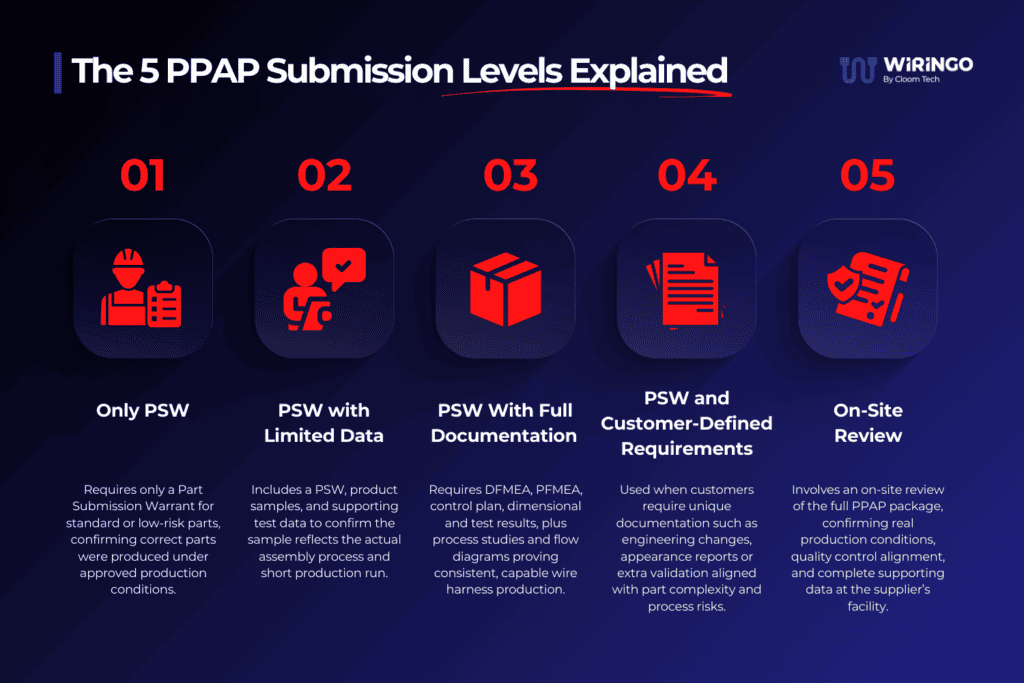
The PPAP process outlines the submission structure suppliers follow when preparing production parts for customer review. These levels guide how the production part approval process organizes documents, product samples, and complete supporting data, as well as the steps used during production to confirm that each part meets the required quality standards.
They also help define the PPAP requirements for each build, ensuring suppliers and their production teams clearly understand customer expectations for approval before manufacturing begins under normal production conditions.
Level 1: Only PSW
Level 1 requires a Part Submission Warrant with minimal documentation. This level applies to standard or low-risk parts where the customer only needs confirmation that the correct part was produced under approved production conditions.
Level 2: PSW with Limited Data
Level 2 includes a part submission warrant, product samples, and material test results. This level helps confirm that a sample part reflects the assembly process and the process used during a short production run.
Level 3: PSW With Full Documentation (Most Common for Wire Harnesses)
Level 3 is the most common approach for a PPAP wire harness assembly. It can include DFMEA, PFMEA, the control plan, dimensional results, and tests performed on the part to confirm that the process is capable of consistently producing parts or products that meet customer expectations.
It also includes initial process studies, statistical process control checks, and a process flow diagram that explains the process flow from start to finish.
Level 4: PSW and Other Customer-Defined Requirements
Level 4 applies when the customer defines unique documentation requirements. These may include engineering change documents, appearance approval reports, or extra validation evidence that reflects the complexity of the part and the potential process risks involved.
These documents are negotiated during the quoting process because PPAP requirements and expectations for process control can vary.
Level 5: On-Site Review
Level 5 requires an on-site review where the full PPAP package is evaluated at the supplier’s manufacturing location. This review at the supplier’s manufacturing site confirms the manufacturing process can produce parts as planned under actual production conditions.
It includes PSW with product samples, verification records, and complete supporting data, as well as proof that quality control checks meet the build’s quality requirements. This level is the most detailed because it provides a summary of the entire PPAP directly at the source.
PPAP Documentation for Wire Harness Manufacturers
A complete PPAP wire harness package follows Automotive Industry Action Group expectations, though the documentation is adjusted for custom cable assemblies.
These records support the PPAP submission by demonstrating how the production part approval process confirms the readiness of the planned manufacturing process. Each element helps verify that the PPAP requirements are satisfied before the part moves toward mass production.
Design Records
Design records include engineering drawings, three-dimensional models, and harness wiring schematics. Customer approval records confirm final design intent before the build enters the PPAP wire harness review stage.
Process Flow Diagram
The process flow diagram outlines each operation in sequence so the customer can see how the harness will move through the build process.
PFMEA (Process Failure Mode and Effects Analysis)
PFMEA identifies potential process failures such as crimp deformation or misrouting. It also defines the actions needed to limit these risks and support reliable operation during the production process.
Control Plan
The control plan lists inspection frequency, measurement methods, and acceptance criteria for each operation. This supports quality control by documenting how the process will be monitored.
Measurement System Analysis (MSA) and Test Results
Measurement system analysis confirms that measurement tools produce consistent readings. Test results show that the selected methods can support product quality when used during the production run.
Part Submission Warrant (PSW)
The Part Submission Warrant confirms that the PPAP requirements have been met and that the part is ready for release. It serves as the approval record that completes the entire PPAP submission.
Common PPAP Mistakes in Wire Harness Manufacturing (And How To Avoid Them)
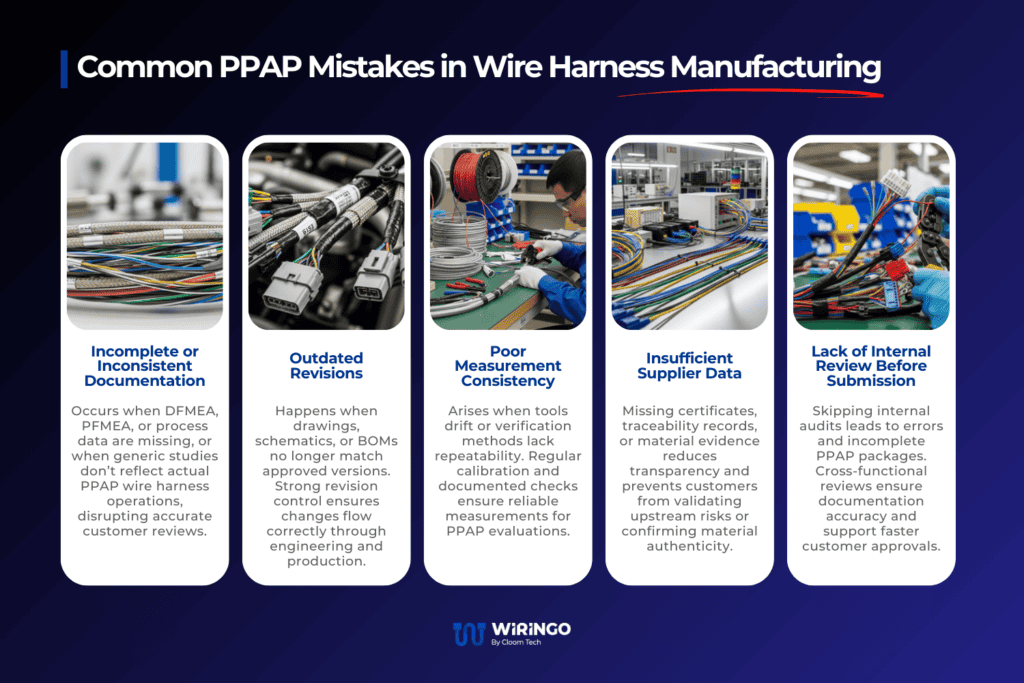
Common PPAP review failures often stem from incomplete documentation or a disconnect between the plan and actual production. These gaps affect compliance in manufacturing and slow approval for any PPAP wire harness.
Problems often begin when teams manage an existing part with outdated controls instead of using documentation that outlines the entire process. Since PPAPs are usually negotiated at the start of a project, suppliers must focus on completing the process requirements to avoid delays.
Incomplete or Inconsistent Documentation
Incomplete documentation appears when DFMEA, PFMEA, or process data are missing or when teams reuse generic studies that don’t reflect the actual operations for the PPAP wire harness.
These gaps interrupt customer reviews and create uncertainty about how risks were evaluated. A complete set of records must match the intended production sequence to support accurate assessment.
Outdated Revisions
Outdated drawings, wiring schematics or bills of materials create mismatches between what was approved and what’s being built.
Revision control should link directly to ERP systems so changes flow through engineering, purchasing, and production without delay. This prevents incorrect builds and maintains alignment for the existing part.
Poor Measurement Consistency
Measurement inconsistency arises when tools drift or when verification methods don’t produce repeatable results.
Regular calibration and documented checks support dependable readings during PPAP evaluations. These steps confirm that measurement methods can identify variation before it affects production.
Insufficient Supplier Data
Missing supplier evidence, such as certificates of conformity or traceability records, limits transparency. These records confirm that materials meet specifications and support compliance in manufacturing. Without them, customers can’t validate upstream risk controls or confirm material authenticity.
Lack of Internal Review Before Submission
Skipping internal audits leads to avoidable errors and incomplete submissions. Cross-functional PPAP reviews verify that documentation matches the intended process and that all evaluations are accurate. This step improves submission quality and supports faster customer decisions.
How Wiringo Implements PPAP for Custom Wire Harness Projects
Within an ISO 9001 and IATF 16949-based quality system, Wiringo uses PPAP standards to support each PPAP wire harness project.
The documentation covers Process Failure Mode and Effects Analysis (PFMEA), control plans, and validation testing, in accordance with IPC-WHMA-A-620, providing customers with full transparency into the quality control processes designed to achieve the required quality level.
Digital approval workflows help speed up reviews and maintain full traceability of the build. These workflows also help teams understand the level of PPAP submission approval for the project, ensuring documentation aligns with customer expectations from the start.
Work with Wiringo for fully documented, production-ready wire harnesses that meet strict PPAP standards.
Get Your Free Sample!
Explore our custom services now. Email us at [email protected] for more details.