


First Article Inspection for Wire Harnesses (FAI) sets the foundation for precise manufacturing. This early checkpoint measures how the first item built aligns with the design specifications, wire routing plans, approved materials, and controlled production actions performed by qualified personnel.
Each inspection step captures measurable data that demonstrates how the manufacturing process performs under real production conditions. Documenting this information at the outset creates a clear, traceable reference point that supports process validation and ensures future production runs remain consistent, repeatable, and compliant with quality requirements.
Get Your Free Sample!
Explore our custom services now. Email us at [email protected] for more details.
What Is a First Article Inspection for Wire Harnesses?
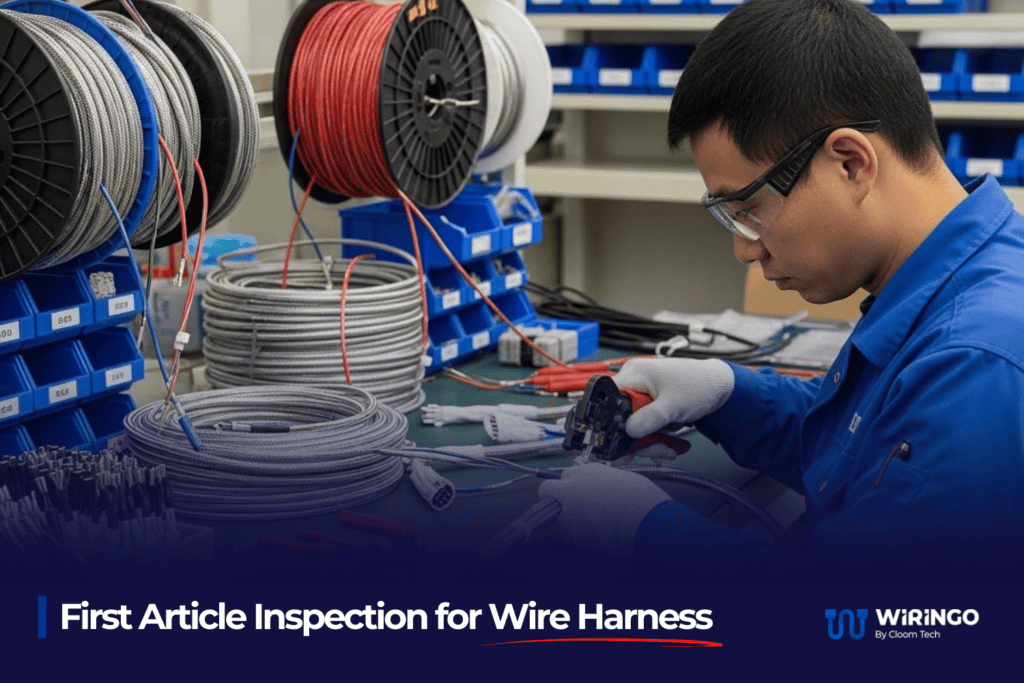
A First Article Inspection verifies that the initial wire harness produced meets all specified requirements before full production begins. It provides documented evidence that engineering drawings, customer specifications, and the bill of materials were correctly interpreted and applied during manufacturing.
Standards such as AS9102 for formal FAI, along with IPC/WHMA-A-620 and ISO-based quality systems, define how manufacturers document characteristics and process controls across components, routing, and terminations.
In-process or final checks verify individual steps or the finished product, whereas first article inspection validates the entire build path. It confirms that the production process operates as intended across tools, materials, methods, and workflows, making it a comprehensive verification method rather than a limited inspection of isolated parts.
Why First Article Inspections Are Important in Wire Harness Manufacturing
The first article establishes the direction for all future production by confirming that the manufacturing process meets the required specification before volume production begins. When the initial unit matches the defined criteria, teams avoid costly rework and production errors that lead to delivery delays and downstream quality escapes.
This early verification establishes a stable baseline for quality control and provides reliable data on how the full assembly process performs under real-world conditions.
The documented inspection record demonstrates to customers and auditors that the engineering requirements and design specifications were applied correctly during the first-article build. These findings support compliance for automotive programs under IATF 16949, aircraft work under AS9100, and military projects that require consistent workmanship.
By confirming conformity at the start, you strengthen long-term quality assurance and maintain a controlled path from prototype to final production.
Get Your Free Sample!
Explore our custom services now. Email us at [email protected] for more details.
Your FAI Checklist: What to Verify
A complete First Article Inspection report captures all characteristics needed to confirm that the first article and any related cable assemblies meet the required specification.
Use this checklist to verify every requirement before moving on to mass production.
1. Documentation and Drawings
- Verify the full drawing package is complete and at the latest approved revision.
- Confirm the Bill of Materials matches the drawing and revision level.
- Check that all specified vendors appear on the Approved Vendor List.
- Validate part numbers, materials, and component specifications against customer and engineering requirements.
2. Dimensional and Physical Verification
- Measure wire lengths, routing paths, bend points, and component placement.
- Record all dimensional data with documented measurement locations and conditions.
- Inspect internal components before overmolding or sealing to confirm conformance, as they will no longer be visible.
3. Electrical Testing
- Perform continuity testing to verify correct circuit paths.
- Conduct high-potential and insulation resistance testing per the specification.
- Record all test results and compare them to defined tolerance limits.
- Verify test equipment calibration and attach all applicable certificates of conformance.
4. Visual and Mechanical Inspection
- Inspect crimps, solder joints, strain relief, and labeling to IPC WHMA A 620 requirements.
- Confirm connector alignment, terminal condition, and mechanical integrity.
- Verify that all mechanical features support the long-term reliability of the assembly.
5. Documentation and Approval
- Attach completed First Article Inspection forms, photos and test data.
- Retain electronic records for audit readiness, revision control and future builds.
- Confirm approval and release of the first article before proceeding to production.
Common FAI Pitfalls and How to Overcome Them

First Article Inspection in wire harness manufacturing requires strict control, as every requirement defined in the engineering drawings, specifications, and materials list must be verified against the first article before production scales. Any gaps at this stage can lead to performance issues, noncompliance, or downstream delays.
Wiringo applies a structured quality assurance system to eliminate uncertainty early in the process. Each First Article Inspection is guided by complete documentation, defined inspection criteria, and controlled workflows that enable a consistent and reliable transition into full production.
Pitfall 1: Outdated Documentation
Problem:
Using outdated drawings, specifications, or bills of materials leads to assemblies that no longer match the approved engineering intent. Assemblers may unknowingly follow superseded requirements, resulting in nonconforming builds and rework.
Solution:
Implement a robust revision control system tied directly to your Enterprise Resource Planning system so production teams always access the latest approved documentation. Lock obsolete revisions, require revision verification before release, and enforce document control checkpoints at FAI kickoff.
Pitfall 2: Incomplete or Vague Work Instructions
Problem:
Unclear routing paths, undefined tolerances, or missing assembly details force technicians to interpret intent during the first build. This increases variability and creates inconsistency that can carry into volume production.
Solution:
Develop detailed, print-aligned work instructions that mirror the approved documentation. Use visual aids, defined inspection points, and explicit acceptance criteria to eliminate interpretation during the FAI build.
Pitfall 3: Incorrect Material or Component Selection
Problem:
Selecting the wrong cable type, connector, or shielding configuration can lead to premature failure, especially in applications involving vibration, electromagnetic interference, or tight mechanical tolerances.
Solution:
Verify all materials against the Approved Vendor List during kitting and incoming inspection. Confirm cable construction, shielding, and component ratings align with the print before assembly begins.
Pitfall 4: Kitting and Supply Chain Gaps
Problem:
Missing parts, uncertified materials, or incorrect quantities disrupt the FAI process and introduce delays or substitutions that violate the approved design.
Solution:
Conduct pre-FAI kitting audits to confirm completeness and certification of all materials. Require supplier documentation and lot traceability before releasing the build to the floor.
Pitfall 5: Skipping or Rushing the First Article Inspection
Problem:
Bypassing or compressing the FAI step allows defects to enter production unchecked. These issues often scale quickly, increasing scrap, rework, and customer risk.
Solution:
Treat FAI as a mandatory gate, not a formality. Use in-process inspections, documented verification steps and short feedback loops to identify issues early and correct them before production release.
Pitfall 6: Limited Cross-Functional Alignment
Problem:
Lack of coordination between engineering, quality, and production teams creates blind spots that surface late in the inspection process.
Solution:
Engage all stakeholders early through structured FAI reviews. Clear ownership, shared documentation access, and defined approval steps create a controlled path from first article to full production.
A disciplined FAI process replaces ambiguity with clarity. Careful preparation, controlled documentation, and deliberate verification reduce risk and ensure repeatable quality across every production run.
Wiringo’s Approach to First Article Inspection
Wiringo operates under ISO 9001 and IATF 16949-certified quality management systems that guide each stage of first-article inspection for wire harness manufacturing. These systems support a clear manufacturing process that documents how the first article progresses from material intake through controlled builds that meet the required specifications.
The path begins with an inbound inspection to verify materials, followed by a structured First Article build that captures the measurable characteristics needed for conformity. Testing then confirms that the assembly and related cable assemblies meet the defined criteria through electrical checks, visual reviews, and detailed inspection records that support stable future production.
Partner With Wiringo for Verified Harness Production
At Wiringo, we follow a controlled First Article Inspection process that supports reliability and compliance across every wire harness we manufacture. This approach gives you a clear, documented path from prototype to full production.
Our team brings broad industry experience across programs that require measurable conformity and stable, repeatable performance. You also get fast quoting and transparent communication at every stage, helping you move from the first article to long-term production with confidence.
Contact Wiringo to discuss your next wire harness project and learn how our rigorous FAI process guarantees quality from the very first piece.
Get Your Free Sample!
Explore our custom services now. Email us at [email protected] for more details.