


A low-voltage (LV) distribution panel is the central nervous system of any industrial or commercial electrical system. It safely divides a main power supply into smaller, protected circuits that feed everything from production machinery to building services.
A high-reliability LV panel does more than just route power. Its core purpose is to deliver it with certainty, built upon three pillars of electrical protection:
- Overload Protection: Prevents circuit damage from excessive current draw during normal operation.
- Fault Isolation: Instantly disconnects a circuit during a severe fault (like a short-circuit) to prevent fire and catastrophic damage.
- Selective Coordination: Ensures only the breaker closest to the fault trips, keeping the rest of your facility online and operational.
This guide explains the core panel types, components, and design principles that turn these concepts into a reliable, real-world asset.
Get Your Free Sample!
Explore our custom services now. Email us at sales@wiringo.com for more details.
From Main Feed to Final Circuit: The Tiers of Distribution
LV distribution systems use a tiered structure—typically main, sub-main, and final distribution boards—to move power from the source to the load. This staged approach improves safety, simplifies fault isolation, and allows for planned growth. From utility substations and data centers to industrial machinery and renewable energy sites, these panels form the backbone of nearly every modern electrical system.
Main Distribution Board (MDB): The System’s Entry Point
The MDB receives power directly from the utility or transformer. Housing high-capacity breakers (ACBs/MCCBs), it protects the entire facility at its source and feeds power to sub-main boards and high-demand equipment.
Sub-Main Distribution Board (SMDB): Zone-Level Power Control
The SMDB takes a feed from the MDB and distributes power to specific zones or functions, like a production line or an HVAC system. This allows for targeted load control and enables maintenance in one area without disrupting the entire facility.
Final Distribution Box (FDB): End-Point Circuit Protection
The FDB supplies power directly to end-point equipment, such as lighting, outlets, and machinery. It uses smaller protective devices (MCBs/RCDs) to contain faults to a single circuit, preventing wider system disruption.
Where LV Distribution Panels Are Used
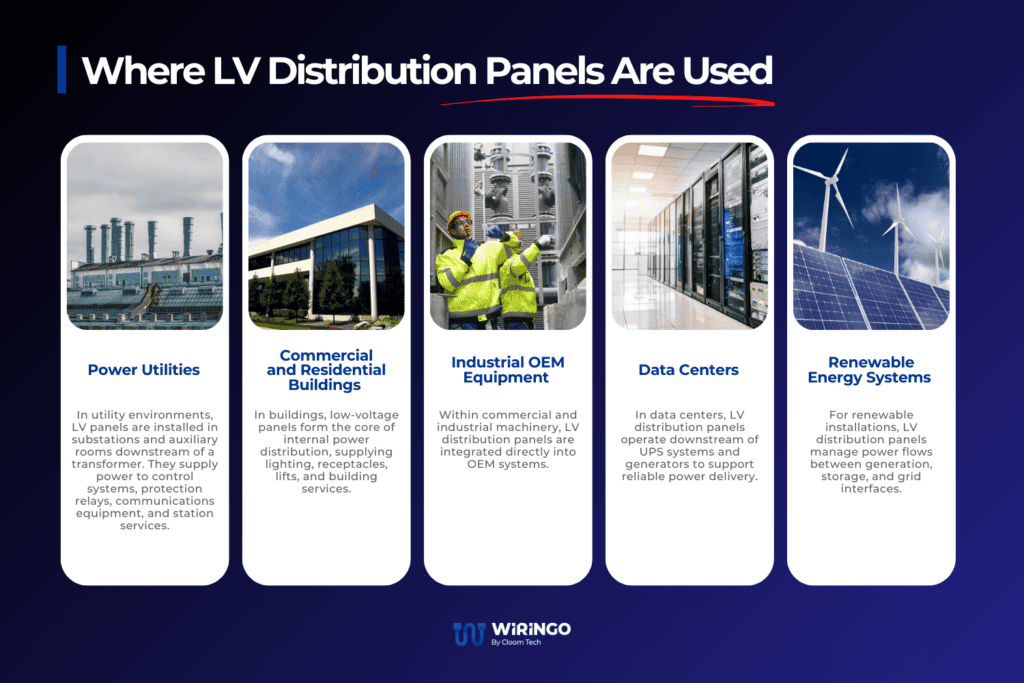
LV distribution panels divide, protect, and control power across multiple circuits within an electrical distribution system. In every environment, they ensure safe, selective delivery of power from a defined source to downstream loads.
Power Utilities
In utility environments, LV panels operate downstream of transformers in substations and auxiliary rooms. They supply power to control systems, protection relays, communications equipment, and station services.
- Auxiliary supply: Powers control systems, protection relays and communications equipment that keep substations operational.
- Switching function: Enables safe isolation of outgoing circuits during maintenance.
- Protection role: Detects and clears faults before they spread into the wider distribution system.
- Interface point: Connects low-voltage systems to higher-level utility infrastructure for coordinated operation.
Commercial and Residential Buildings
In buildings, low-voltage panels form the core of internal power distribution, supplying lighting, receptacles, lifts, and building services.
- Load segregation: Separates lighting, power, and mechanical loads to improve organization and safety.
- Protection coordination: Matches circuit breaker ratings to branch and feeder requirements to ensure selective tripping.
- Safety control: Limits overload and short-circuit energy to reduce fire and equipment damage risk.
- System structure: Supports structured wiring and accommodates future tenant or floor expansion.
Industrial OEM Equipment
Within commercial and industrial machinery, LV distribution panels integrate directly into OEM systems to manage internal power distribution.
- Machine supply: Delivers controlled power to motors, drives, controls, and instrumentation.
- Fault management: Aligns protection settings to machine fault levels to prevent equipment damage.
- Layout alignment: Supports efficient enclosure design and optimized internal current flow paths.
- Service access: Allows technicians to isolate machinery for maintenance without interrupting upstream systems.
Data Centers
In data centers, LV distribution panels operate downstream of UPS systems and generators to support reliable power delivery.
- Conditioned power: Distributes stabilized power supply to IT and cooling loads.
- Redundancy support: Maintains A-B feeds and enables selective isolation to preserve continuity.
- Monitoring interface: Integrates metering and status feedback for real-time visibility.
- Uptime protection: Contains faults quickly to prevent cascading outages.
Renewable Energy Systems
For renewable installations, LV distribution panels manage power flows between generation, storage, and grid interfaces.
- Source integration: Accepts output from solar arrays or wind systems and routes it safely downstream.
- Inverter coordination: Directs power to conversion and storage equipment for efficient system performance.
- Isolation capability: Enables safe servicing and rapid fault clearing.
- Grid connection: Maintains compliant operation in both grid-tied or islanded modes.
Get Your Free Sample!
Explore our custom services now. Email us at sales@wiringo.com for more details.
Anatomy of a High-Reliability Panel: Key Components & Design Principles
A panel’s performance is dictated not just by its parts, but by how they are engineered to work together. Here are the core elements and design principles that define a truly robust LV distribution panel.
Protective Devices (ACBs & MCCBs)
These are the panel’s active defenders. Proper selection and a coordination study using Time-Current Curves (TCCs) ensure they achieve selective coordination, meaning a local fault won’t cause a widespread outage.
Busbars & Internal Conductors
As the backbone of the panel’s power distribution, busbars must be sized and braced to withstand extreme mechanical and thermal forces during short-circuit conditions. This prevents catastrophic failure and protects the entire system.
Enclosure & Thermal Management
The enclosure must have the correct IP rating to protect against environmental hazards. The internal layout is engineered for passive thermal management, using proper component spacing and wire routing to dissipate heat and prevent premature component failure.
Wiring, Terminals & Labeling
Clear routing, secure terminations, and durable labeling are hallmarks of a quality build. They reduce electrical noise, simplify maintenance, and dramatically lower troubleshooting time over the panel’s lifecycle.
LV Distribution Panel Assembly Process
Assembly converts a validated design into a physical unit through controlled sequencing and inspection. Each stage builds on the previous one, with checkpoints that reduce rework and confirm conformity before progression.
- Documentation capture: Records results for traceability and release approval.
- Mechanical Build & Layout: Precisely mounting all structural elements and core components according to the design, ensuring proper clearances and service access.
- Electrical Wiring & Integration: Routing all conductors and integrating pre-built wire harnesses according to IPC standards, focusing on termination quality and path segregation.
- System Verification & Testing: Performing a battery of automated tests—including continuity, insulation resistance (Hipot), and functional checks—to digitally validate that the panel meets all safety and performance specifications.
How Assembly Quality Affects Panel Reliability
A perfect design can be rendered useless by a flawed assembly process. The discipline applied during the build—from the torque of a terminal screw to the verification of a wiring path—ultimately determines a panel’s long-term performance and safety. This is where a manufacturer’s process control becomes the customer’s greatest asset.
The Wiringo Advantage: From Blueprint to Bulletproof Panel
A perfect design can fail if the assembly process lacks discipline. At Wiringo, we build LV panels within a controlled system engineered for repeatability and reliability. This is how we deliver quality and certainty:
Dedicated Lines for Unmatched Consistency
Your panels are built on assembly lines configured specifically for enclosures. Fixed tooling and station-based work eliminate variations from piece to piece, ensuring that every panel in the batch is exact.
Automated Testing That Guarantees Performance
Our testing isn’t just an afterthought, it’s part of our process. Wire harnesses undergo automated test sequences for continuity, insulation resistance (Hipot), and functional simulation. This removes human subjectivity and digitally proves that every circuit performs to spec before it leaves our facility.
Precision Harness Integration for Flawless Internals
We are wire harness experts first and foremost. Our build-to-print approach ensures that your custom harnesses match your specs exactly, eliminating excess wire, termination strain, and giving you a clean serviceable layout that performs reliably for years.
Full Traceability for Total Accountability
Every panel is governed by digital work instructions under our ISO 9001 and IATF 16949 quality systems. We maintain a complete build history from component batches to operator actions and final test results, providing a level of traceability that mission-critical industries demand.
Partner With Wiringo For LV Distribution Panel Assembly
The reliability of your operation can come down to the quality of just one distribution panel. Design plays a role, but the assembly process is what turns the blueprint into a reliable, safe, durable product.
At Wiringo, we deliver more than high-quality products. We deliver confidence and operational certainty. Our process-driven approach is made for repeatability and ensures your design is executed perfectly, every time.
Ready to bring this level of reliability and certainty to your LV distribution panel projects? Contact the Wiringo team today.
Get Your Free Sample!
Explore our custom services now. Email us at sales@wiringo.com for more details.