


Hipot stands for “high potential” testing. It is a method used to confirm whether cables and electrical equipment can safely withstand high voltage. In this test, a voltage higher than normal operating levels is applied to check that the insulation is strong enough and free of defects.
This step is critical for product safety. It identifies weak points or faults in cables and assemblies before they reach customers, helping to reduce the risk of failures in the field.
For a deeper look at how it works and why it matters, we’ve created a complete guide to high potential cable testing.
Get Your Free Sample!
Explore our custom services now. Email us at sales@wiringo.com for more details.
What Is High Potential (Hipot) Cable Testing?
A hipot test (also sometimes called Dielectric Withstand Test) checks if electrical insulation works properly. We apply a high potential between the conductor and the ground of the device. This places greater stress on the insulation than it would experience under normal operating conditions.
During testing, we measure leakage current through the insulation. Sound insulation allows only a small amount of current to pass through, even when exposed to high voltage. Hipot testing utilizes this principle to identify potential issues, such as pinched wires, loose strands, or improper spacing. All are problems that could otherwise lead to failures in the field.
Purpose
The main purposes of hipot cable testing include:
- Verifying that the electrical insulation in cables functions correctly
- Detecting potential defects such as shorts and open circuits
- Identifying manufacturing issues
- Confirming the effectiveness of safety circuits
- Ensuring equipment can withstand voltage spikes
- Demonstrating compliance with industry safety standards
Types of Products Tested
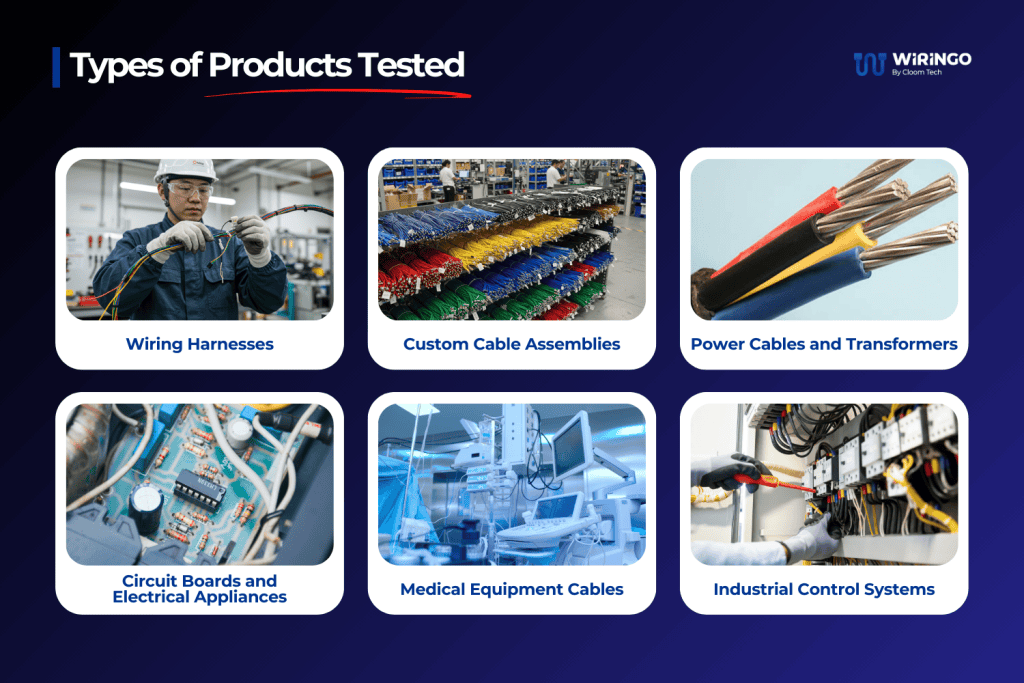
- Wiring harnesses for cars and factories
- Custom cable assemblies
- Power cables and transformers
- Circuit boards and electrical appliances
- Medical equipment cables
- Industrial control systems
Precautions
Always prioritize safety during electrical testing. Each cable requires a specific test voltage. Check the applicable standards before testing.
The high voltages are dangerous. Use the proper insulation and keep a safe distance from equipment. Wear appropriate gear and follow safety rules to stop yourself from getting shocked.
Why Is Hipot Testing Important?

High-voltage testing ensures that devices can withstand voltage spikes during normal operation. Without this ability, devices might malfunction or cause fires.
Test Dielectric Strength
Dielectric strength testing measures how much electric field an insulating material can withstand before it breaks down. This ensures the insulation reliably prevents current from flowing where it should not, even under demanding conditions.
Find Insulation Weaknesses
Testing finds weak spots in insulation. Even minor issues can cause big problems over time. By stressing insulation, we find weak points before they cause operating problems and safety risks.
Comply with Safety Guidelines
Products must meet safety standards. Modern hipot testers work with standards such as IEC 61010. This requires maintaining a specific voltage for a certain amount of time.
Verify Production Quality
Hipot testing serves as an important quality checkpoint in the manufacturing process. By testing each unit, manufacturers ensure consistent performance, verify that products meet design specifications, and maintain high reliability standards across every assembly produced.
Identify Safety Hazards
Testing finds hazards before products reach users. Sound insulation prevents shock, fires, and other dangers.
Hipot Testing vs. VLF (Very Low Frequency) Testing
Both methods test insulation in electrical equipment, but they do so in different ways. VLF testing is best suited for specific applications, while hipot testing is used for others.
Frequency and Voltage
VLF testing uses very low frequencies (0.01-0.1 Hz). Hipot testing uses either DC or AC at 50-60 Hz.
Insulation
These tests evaluate insulation systems in different ways. VLF (Very Low Frequency) testing focuses on long-term reliability by uncovering issues such as water trees, aging, and material degradation. In contrast, Hipot testing targets immediate integrity by applying high voltage to detect current defects, such as weak insulation or physical damage, before equipment goes into service.
Applications
VLF testing is mainly for field cable testing after installation. Hipot testing has broader uses, including manufacturing quality control and maintenance.
Get Your Free Sample!
Explore our custom services now. Email us at sales@wiringo.com for more details.
How Do Manufacturers Perform Hipot Tests?
At Wiringo, we use special equipment for testing our wiring harnesses and cable assemblies. The hipot testing involves careful setup and monitoring.
A typical test setup includes a test kit with an autotransformer, test transformer, rectifying diode (as required by test type), control box, and high voltage leads. We connect the transformer to the cable conductors and ground, then increase the voltage to the test level.
During a Hi-pot test, we apply voltage between specific points and measure leakage current. We isolate the test object and apply voltage for 1 minute. The cable passes if it can withstand high voltage without breakdown.
Hipot Testing Systems and Methods
The right system depends on your product, test parameters, and industry standards.
Manual
Manual testing involves the operator adjusting settings and recording results. This approach is suitable for low-volume production, but it can introduce human error.
Fully Automatic
Automatic test systems handle the entire process with minimal operator involvement. They set parameters, run tests, and record results automatically – ideal for high-volume production.
Voltage Transient and Safety Circuits
Advanced testers manage voltage transients and include safety circuits to control fluctuations and protect against shock hazards.
Maximum Current and Circuit Breakers
Modern hipot testers monitor the maximum allowed current. They stop testing if the leakage current becomes too high, thereby protecting both the equipment and operators.
DC Testing
DC hipot testing offers advantages for specific use cases. It allows higher voltage levels, making it suitable for thick insulation or high-voltage equipment.
However, it may miss certain defects that AC testing can detect, and can cause charge buildup that requires discharge after testing.
AC Testing
AC hipot testing better mimics real-world conditions, as most power systems use AC; DC is used in specific applications. This method effectively finds defects like voids or contamination that DC testing might miss.
What Are the Key Elements of Hipot Testing?
Test Voltage
The applied voltage is higher than the normal operating voltage to stress-test the insulation. We determine voltage based on the equipment specifications and industry standards.
We carefully control the voltage, gradually increasing and decreasing it to prevent damaging the good insulation. And we maintain voltage for the required test duration.
Insulation Resistance and Leakage Current
Testing measures insulation resistance and leakage current. High resistance means sound insulation; low values suggest problems.
Some leakage is normal, but excessive leakage indicates weaknesses. Most testers use leakage current as the main pass/fail measure.
Safety Test Equipment
Modern dielectric strength tests include safety mechanisms to protect users and equipment. Features include automatic shutdown if the leakage current exceeds a certain threshold and automatic discharge after testing.
What Industries Use Hipot-Tested Products?
Hipot-tested products are vital in many industries:
- Automotive
- Medical device manufacturing
- Industrial machinery and control systems
- Consumer electronics and power generation
- Telecommunications systems
Across industries, insulation testing helps ensure products meet strict safety standards. Unlike a continuity test, which verifies proper electrical connections, insulation testing focuses on isolation to confirm that current does not flow where it shouldn’t.
Choose a Cable Assembly Manufacturer That Is Committed to Quality
When selecting a cable assembly manufacturer, choose one that is committed to delivering high-quality products. At Wiringo, we specialize in customized wiring harness solutions, thoroughly testing all cable assemblies.
Our dedication to quality ensures every wiring harness meets or exceeds industry standards. We verify integrity and performance before delivery, giving you reliable, durable, and safe assemblies.
By working with Wiringo, you gain a manufacturer committed to excellence in every step of the production process. We test products with AC test voltage or DC voltage as appropriate for your application.
Ready to discuss your custom wiring harness requirements? Contact Wiringo today.
Get Your Free Sample!
Explore our custom services now. Email us at sales@wiringo.com for more details.