


Industrial wire harnesses support reliable power and signal distribution across manufacturing, robotics, energy systems, and heavy equipment, where wiring must withstand vibration, heat, abrasion, and demanding operating cycles.
By organizing wire and cable into structured bundles, a well-engineered wire harness improves reliability, supports easier installation, and meets the exact specifications required for modern industrial systems.
This guide explains how industrial harnesses work, why they matter, and how Wiringo helps teams build safer, more efficient systems with high-quality wiring solutions.
Get Your Free Sample!
Explore our custom services now. Email us at sales@wiringo.com for more details.
What Is An Industrial Wire Harness?
Industrial wire harnesses are structured electrical assemblies that organize multiple wires and cables into a single, manageable unit designed for efficient power and signal distribution. Unlike loose wiring, a harness groups conductors, connectors, and terminals into a protected system, helping it operate reliably even in heavy-duty industrial environments.
A well-designed wire harness guides every wire through a defined pathway, reducing clutter, improving organization, and simplifying installation. They also help prevent damage from vibration, heat, abrasion, or mechanical movement.
Benefits Of Industrial Wire Harnesses
What are the Benefits Of Industrial Wire Harnesses
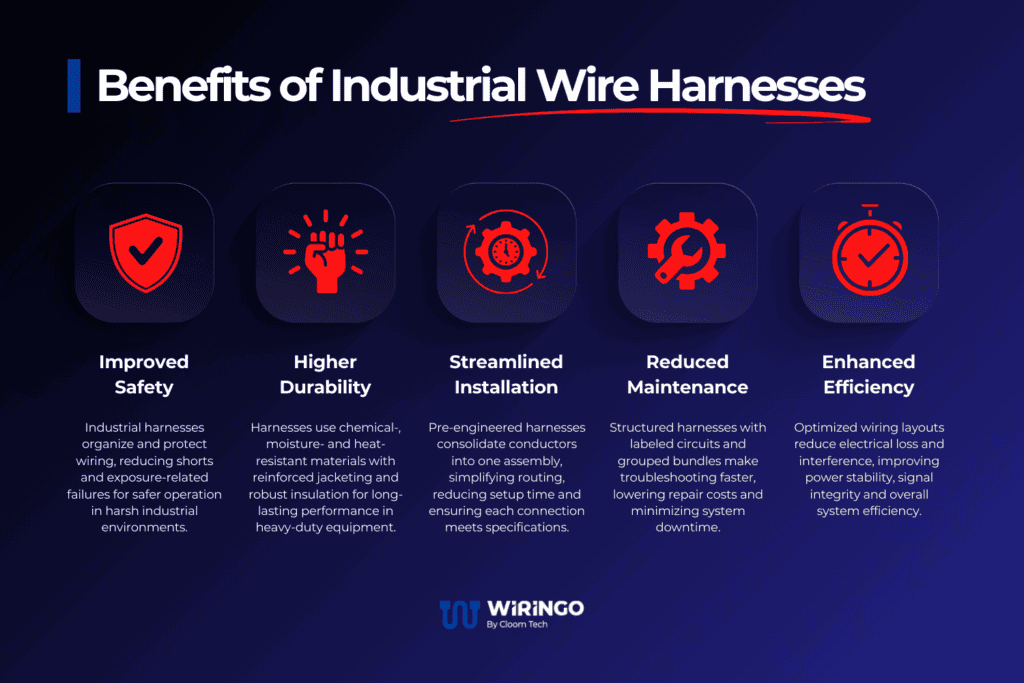
Industrial wire harnesses provide structural, electrical, and organizational advantages that help equipment operate more safely and efficiently. These advantages include:
Improved Safety
Industrial wire harnesses reduce the risk of electrical shorts by keeping wiring organized, protected, and properly routed. By shielding conductors from abrasion, heat, and vibration, a harness or cable assembly minimizes exposure-related failures and supports safer operation in industrial systems.
Higher Durability
Because wire and cable harnesses are built using materials that resist chemicals, moisture and temperature extremes, they offer long-term performance in harsh or heavy-duty environments. Reinforced jacketing, secure connectors and robust insulation help extend service life across off-road, agricultural equipment, manufacturing machinery and more.
Streamlined Installation
Pre-engineered wire harness assemblies reduce installation time by consolidating multiple conductors into a single drop-in solution. Organized routing simplifies setup, eliminates wiring guesswork, and ensures that each connection meets the required specification.
Reduced Maintenance
A structured harness allows technicians to identify issues quickly by tracing designated circuits, labeled conductors, and grouped bundles. This supports easier installation and maintenance, lowers repair costs, and minimizes downtime.
Greater Efficiency
Optimized wiring solutions reduce electrical loss and interference by keeping every wire properly separated, shielded, and routed. The result is more stable electrical power distribution, improved signal integrity, and greater overall system efficiency.
Get Your Free Sample!
Explore our custom services now. Email us at sales@wiringo.com for more details.
Industrial Wire Harness Components And Materials
The materials and components used in an industrial wire harness are selected to support durability, electrical conductivity, and long-term performance. Each element contributes to how the harness manages power distribution, signal transmission, and exposure to environmental stressors within complex industrial systems.
Conductors
Industrial harnesses usually use copper or tinned copper conductor materials because they offer strong electrical performance, corrosion resistance, and flexibility for routing. The conductor selection directly affects how every wire handles current, signal clarity, and mechanical movement.
Insulation and Jacketing
Different forms of wiring require insulation and jacketing compounds such as PVC, TPE, or XLPE to resist chemicals, heat, and abrasion. These materials protect the internal wire and cable structure and help maintain consistent performance in heavy-duty or high-temperature environments.
Connectors and Terminals
Connectors, terminals, and interconnect components support precise mating across industrial cable assemblies. Proper component selection from verified suppliers ensures compatibility, stable electrical contact, and reliable performance in machinery, robotics and automated equipment.
Protective Elements
Additional protection, such as braided sleeving, overmolding, potting, tubing, or grommets, helps shield wire harness assemblies from moisture, vibration, and shock. These features increase durability for heavy-duty applications, including the crane, utilities, and automation sectors.
Labels and Identification
Clear labeling, barcodes, and identification markers support installation and maintenance by helping technicians trace circuits, verify specification requirements, and document system changes. This is especially important for environments requiring quality control, traceability and compliance with industry standards such as IPC, UL, and ISO certifications.
How Industrial Wire Harnesses Are Used Across Industries
Standard harnesses work well when equipment follows established layouts and does not require specialized environmental performance. More complex environments require custom wire harnesses engineered for extreme conditions, unique routing or mission-critical performance.
Industries Using Standard Industrial Wire Harnesses
Ideal Applications For Overmolding
- Manufacturing & Control Panels: Used in CNC machines, assembly lines, PLC controls, and automated equipment where structured wiring and stable interconnect paths support everyday operations.
- HVAC Systems: Harnesses manage blower controls, thermostats, motors and electrical paths, simplifying routing and improving installation efficiency.
- Utilities & General Industrial Systems: Common in power distribution equipment, industrial cable routes, and facility infrastructure where predictable wire and cable configurations are required.
- Robotics & Motion Control (Standard Layouts): Off-the-shelf cable harness and wire assemblies work in systems with moderate movement and known routing paths.
- Telecommunications: Used in switches, panels, and networking equipment where standardized wire harnesses and cable assemblies support signal and power distribution.
Industries Using Custom Industrial Wire Harnesses
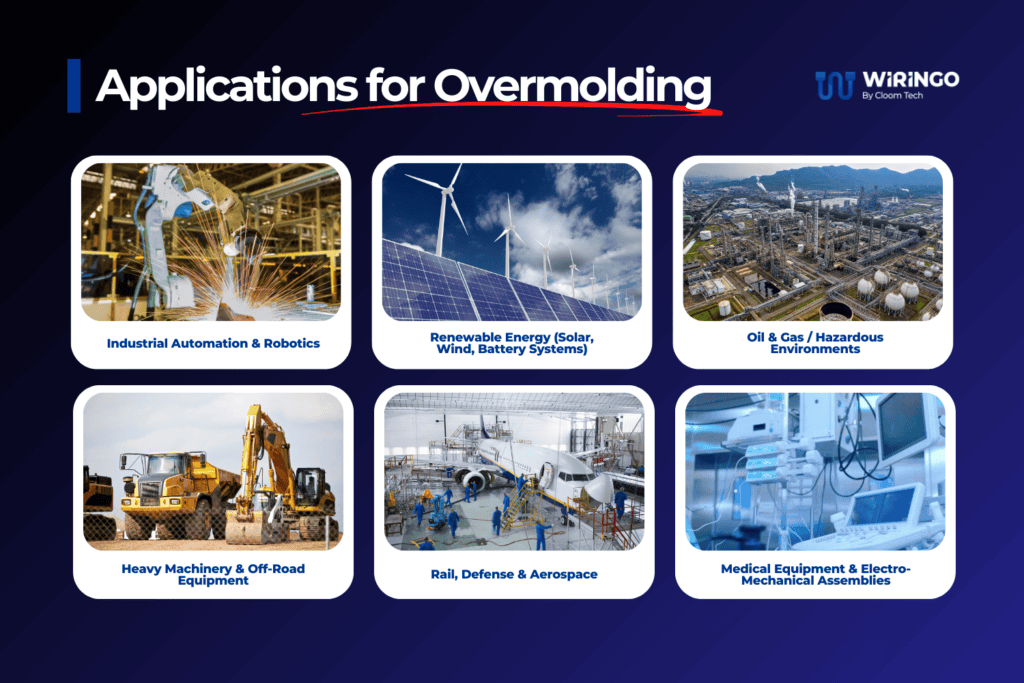
- Industrial Automation & Robotics: Custom harnesses support PLCs, sensors, actuators, and robotics where flexible routing and durability are essential.
- Renewable Energy (Solar, Wind, Battery Systems): Weatherproof, UV-resistant custom cable and harness assemblies maintain performance in outdoor, high-voltage conditions.
- Oil & Gas / Hazardous Environments: Explosion-resistant industrial wire harnesses withstand chemicals, heat, pressure, and corrosive atmospheres.
- Heavy Machinery & Off-Road Equipment: Rugged harnesses for construction, mining, and agricultural equipment built to tolerate vibration, dust, and extreme temperatures.
- Rail, Defense & Aerospace: EMI-shielded, precision-tested harnesses for mission-critical reliability, often meeting IPC, UL, ISO, or AS9100 certified requirements.
- Medical Equipment & Electro-Mechanical Assemblies: High-quality harnesses for diagnostic devices, imaging systems, and sensitive electronics requiring stable power and clean signals
Custom vs. Standard Options
Choosing between standard and custom industrial wire harnesses depends on the equipment’s wiring demands, environmental exposure, and performance requirements. While off-the-shelf options work for predictable layouts, many industrial systems benefit from a tailored approach that aligns the harness with the machine’s exact electrical and mechanical needs.
When Standard Industrial Wire Harnesses Are Sufficient
Standard industrial wire harnesses are suitable for equipment that follows established wiring layouts and doesn’t require specialized routing, harsh-environment protection, or unique connector configurations.
These off-the-shelf harnesses support predictable products and applications, offering a low-cost solution when electrical paths, mounting points, and environmental exposure are consistent across units.
Why Custom Industrial Wire Harnesses Offer GreaterCompatibility
In complex machinery, industrial systems, robotics, automated equipment, and heavy-duty platforms, a standard wire harness may not provide the correct geometry, environmental protection, or interface requirements.
Custom wire harnesses are engineered to match exact specifications, including conductor types, insulation materials, connector interfaces, protective elements, and routing constraints. They deliver improved compatibility and more stable electrical power and signal performance.
Engineering Collaboration for Tailored Assemblies
Wiringo’s engineering team works closely with clients to design, prototype, and validate wire harness assemblies that meet project-specific requirements. Through collaborative wire harness manufacturing practices, detailed component selection, and iterative testing,
We develop top-quality harnesses aligned with system architecture, installation needs, and the equipment’s electrical and mechanical demands.
Build Safer, More Reliable Systems With Wiringo
Wiringo designs and manufactures high-quality custom industrial wire harnesses with end-to-end engineering support, from consultation and prototyping to testing and full-scale production.
We offer flexible order quantities, short lead times, and global supply chain capabilities, all backed by ISO 9001 and IATF 16949 certification. Our team delivers reliable, custom-built wire and cable solutions with full traceability, automated QA, and advanced manufacturing methods like ultrasonic welding and overmolding.
Need a durable harness for your industrial system? Request a free quote today.
FAQs
Which design files are most useful when collaborating on a new harness?
3D models of the equipment (STEP/IGES), 2D drawings (DXF/DWG), wiring diagrams, pinout tables, and existing schematics are all extremely helpful. They allow the harness team to check fit, define branch points, and verify that connector orientations and lengths work in the real installation.
How do I know if my current wiring setup should be converted into a harness instead of loose wires?
Warning signs include frequent wiring errors during assembly, long installation times, difficulty tracing circuits during troubleshooting, and recurring damage from vibration or abrasion. If several of these are happening at once, consolidating into a harness usually reduces defects and lifecycle cost.
What testing should I expect from a professional industrial wire harness manufacturer?
Typical test regimes can include continuity and shorts testing, hipot/dielectric strength checks, insulation resistance, pull-force testing on terminations, and, where relevant, thermal cycling, flex testing, and vibration exposure. For many projects, automated test fixtures are built so each harness can be verified to the same standard.
Get Your Free Sample!
Explore our custom services now. Email us at sales@wiringo.com for more details.