


Mining sites push cables to their limits. Standard wires break quickly in these demanding conditions. That’s why mining operations need specialized mining equipment cable assemblies.
These cable assemblies keep equipment running in harsh environments. The right cables prevent costly breakdowns and delays. Let’s examine what makes mining cable solutions so important.
Get Your Free Sample!
Explore our custom services now. Email us at [email protected] for more details.
What Type of Cable Assemblies Are Used for Mining Equipment?
Tough cable assemblies, designed for extreme conditions, are used to connect power and data to equipment in challenging environments.
These mining cable assemblies feature specialized designs to withstand challenges such as rocks, water, and chemical exposure. They resist damage from constant movement and rough handling. Most mining cables utilize materials such as rubber or polyurethane jackets. The inside contains copper or aluminum wires with special insulation to withstand vibration and stress.
Different mine operations need different cable types. Moving equipment needs flexible, rugged cables. High-voltage equipment needs cables with extra insulation and shielding for signal protection.
Industry trends indicate that the demand for mining cables and their assemblies is increasing as mining companies utilize more technology and automated machines. They also need better cables for new communication networks, like 5G.
Why Are Cable Assemblies Important for Mining?
Mining demands rugged, reliable connectivity. Standard cables fail fast under abrasion, impact, moisture, and vibration. Heavy equipment, such as drills, haul trucks, and conveyor systems, requires power and signal lines that remain online in harsh conditions.
Quality mining cable solutions have the following properties:
- Prevent accidents and hazards
- Reduce repair costs
- Minimize downtime
- Meet safety regulations
- Protect workers
- Last longer in demanding environmental conditions
Poor cables lead to shutdowns, repairs, and safety issues. The right wire and cable choices save money and improve productivity.
What are the Components of Mining Cable Assemblies?
Mining cable harnesses combine several parts designed for harsh conditions.
- Conductors: Copper or aluminum wires that carry electricity
- Insulation: Protective layer that prevents electrical shorts
- Shielding: Metal layer that blocks interference for control signals
- Jacket: Tough outer covering that protects against abrasion
- Connector: End fittings that create secure connections
- Strain relief: Parts that prevent pulling damage
- Ground wires: Safety wires that prevent shock hazards
- Fillers: Materials that maintain cable shape during flex
Mining cable assemblies vary by design and materials. Trailing and shuttle power cables face constant movement, so they use flexible, abrasion-resistant sheaths. High-voltage power cables prioritize insulation and shielding to handle electrical stress. Understanding these differences helps you select the right cable for each operating scenario.
Get Your Free Sample!
Explore our custom services now. Email us at [email protected] for more details.
Mining Cable Assembly Features
When selecting cable assemblies for mining equipment, certain features make the difference between constant failures and reliable performance.
The best cable assemblies combine specialized materials and construction techniques for mining’s unique challenges. That includes extreme temperature swings, constant vibration, chemical exposure, and physical abuse.
Understanding these critical features helps mining operations select products that reduce maintenance costs, enhance safety, and prevent the costly downtime associated with cable failures.
| Feature | Importance | Benefit |
| Durability | Critical | Withstands rough handling in challenging environments |
| Flexibility | High | Bends without breaking during deployment |
| Heat/Fire Resistance | Essential | Stays safe even in extreme temperatures |
| Weather Resistance | Required | Works in a wet and dusty environment |
| Vibration Resistance | Necessary | Keeps working despite heavy equipment vibration |
| Contaminant Protection | Important | Resists oils, fuels, and chemicals |
| Abrasion Resistance | Critical | Stands up to rocks and rough surfaces |
| Electrical Performance | Essential | Delivers reliable power |
| Safety Features | Mandatory | Protects workers from electrical hazards |
Durable Build
Key Metrics:
- Outer jacket tensile strength exceeding 20 MPa
- Resistance to impacts above 100 J
- Abrasion life tested to >1500 cycles
Design Focus:
- Multi-layer sheathing that absorbs mechanical stress
- Use of composite elastomers for cut-through resistance
- Optional armor or braiding for maximum surface protection
In Practice:
- Maintains performance under rock strikes and heavy loads
- Reduces costly downtime from jacket damage
- Extends service intervals in harsh underground sites
Mechanical Flexibility
Key Metrics:
- Bend radius capability down to 7–8× cable diameter
- Flex endurance exceeding 1 million movement cycles
- Torsional stability under ±180° twist per meter
Design Focus:
- Fine-stranded conductors to avoid fatigue
- Flexible polymers engineered to resist cracking
- Optimized insulation layering for smooth motion
In Practice:
- Remains pliable on cable reels and moving equipment
- Simplifies installation in confined tunnels and shafts
- Prevents conductor breakage from repeated bending
Thermal and Flame Safeguards
Key Metrics:
- Continuous temperature tolerance: -40 °C to +90 °C
- Meets IEC/UL flame test standards for fire survival
- LSZH (low smoke, zero halogen) jacket options available
Design Focus:
- Compounds that self-extinguish when exposed to flame
- Insulations with low toxicity emissions in fire events
- Heat-stabilized layers that resist deformation
In Practice:
- Critical for enclosed mine shafts where smoke is dangerous
- Protects workers during electrical fires
- Ensures compliance with mining safety codes
Environmental Shielding
Key Metrics:
- IP67–IP68 ingress protection against dust and water
- UV and ozone resistance exceeding 500-hour test cycles
- Hydrophobic materials prevent moisture uptake
Design Focus:
- Fully sealed connectors with gaskets and boots
- Jackets engineered for outdoor exposure longevity
- Anti-cracking formulations for cold environments
In Practice:
- Reliable in open-pit operations or flooded tunnels
- Handles wide seasonal climate swings without degradation
- Cuts down on failures caused by water or dust ingress
Vibration and Shock Resistance
Key Metrics:
- Vibration tolerance from 10 Hz to 2000 Hz
- Shock resistance above 50 g acceleration
- Electrical continuity maintained within <1% variation
Design Focus:
- Strain-relief systems built into terminations
- Fillers and dampening layers inside cable cores
- Locking connectors designed to resist loosening
In Practice:
- Prevents electrical dropouts in drilling rigs and haulers
- Extends cable and connector lifespan under continuous motion
- Improves safety where equipment generates constant shock loads
Contaminant Defense
Key Metrics:
- Resistant to oils, fuels, and hydraulic fluids per ASTM standards
- Dust ingress protection to IP6X level
- Materials engineered for chemical and microbial resistance
Design Focus:
- Jackets with fluoropolymer or synthetic rubber blends
- Sealed connector housings with resistant gaskets
- Compounds designed to withstand corrosive exposure
In Practice:
- Protects electrical systems in areas with fuel spills
- Reliable even in dusty, slurry-heavy mining environments
- Maintains insulation integrity under chemical exposure
Abrasion Hardening
Key Metrics:
- Cut-through force tolerance above 50 N
- Abrasion resistance >2000 test cycles
- Jacket hardness Shore A >80 for surface durability
Design Focus:
- Thickened outer jackets to absorb scraping
- Optional aramid or fiberglass reinforcement layers
- Surface finishes to resist gouging and wear
In Practice:
- Essential for drag cables pulled across rock and metal
- Prevents jacket breaches that expose conductors
- Reduces replacement frequency in rough contact zones
Electrical Integrity
Key Metrics:
- Insulation resistance ≥10⁹ Ω/km
- Voltage withstand from 600 V up to 2 kV
- Stable performance under temperature cycling
Design Focus:
- Shielding to reduce EMI in control cables
- Multi-core construction for power and signal pathways
- Conductors sized to minimize voltage drop over long runs
In Practice:
- Supports high-power mining equipment
- Ensures sensor signals are not lost in noisy environments
- Maintains efficiency under heavy continuous loads
Worker Safety Enhancements
Key Metrics:
- Compliance with MSHA, IEC, and CSA standards
- Integrated grounding conductors with low resistance paths
- Clearly coded insulation for circuit identification
Design Focus:
- Quick-disconnect features for emergency shutdown
- Overcurrent and fault-protection design integration
- Flame-retardant materials across all insulation layers
In Practice:
- Faster response during equipment malfunctions
- Reduced injury risks from electrical faults
- Simplified inspection and maintenance by staff
Mining Equipment Cable Assembly Applications
Mining cable assemblies power critical systems from extraction to processing. Meeting industry standards enhances safety, extends equipment life, and ensures reliability. Because each application faces unique mechanical, electrical, and environmental stresses, cable designs and certifications must align with operating conditions.
Shuttle Cars
Shuttle cars move materials through mines. Their cables must flex constantly while resisting damage from tunnel walls. These cables need strong outer jackets and a flexible design for long-term reliability.
These assemblies must comply with MSHA specifications for flame resistance and ICEA S-75-381 standards for reeling applications, ensuring they can withstand thousands of flexing cycles without creating safety hazards in potentially explosive environments.
Miners
Mining machines, such as continuous miners and longwall equipment, require cables that can withstand vibration and stress. These cables feature extra armor and strain relief to protect against damage during operation.
Compliance with IP67/IP68 ingress protection ratings and MSHA ground-check monitoring requirements is essential, as these machines operate in environments where dust, moisture, and ground faults can create hazardous conditions for workers.
Laser Welding
Welding equipment for mining repairs needs specialized cables. These cables resist high temperatures and provide shielding against electrical interference for precise control signals and data transmission.
These cable assemblies must meet IEC 60332-1-2 fire-resistance standards and EMC requirements to prevent both fire hazards near hot surfaces and signal interference with nearby sensitive equipment in repair facilities.
What are the Different Types of Mining Cables?
Different mining applications need specific cable types. Here are the main options:
Portable power cables
These cables power mobile equipment. They flex easily, have tough jackets, and come in bright colors for enhanced visibility. They withstand dragging and coiling in rough mining conditions.
Trailing cables
Trailing cables connect moving equipment to power sources. They prevent twisting while maintaining flexibility. They work well with equipment that follows set paths.
High-Voltage
These cables carry the main power throughout mining operations. They have special insulation and shielding for safety at high voltages. Choosing the right one depends on your specification needs.
Instrumentation
These cables carry control signals and data. They have special shielding to prevent interference and protect sensitive information from electrical noise.
Type W
Type W cables handle heavy-duty portable power needs. They work for shuttle cars, pumps, and continuous miners. Their copper conductors range in size from 6 AWG to 500 MCM.
G and GG-C
G-GC cables combine power and ground monitoring for safety. They typically handle 2000V and work well for mobile equipment, such as roof bolters. Their conductor sizes range from 8 AWG to 500 MCM.
SHD-GC
SHD-GC (Super Hard Duty) cables are designed to tackle the most challenging mining jobs. They power continuous miners, longwall miners, and various types of loading equipment. They have extra shielding around each conductor for maximum protection.
MP-GC
MP-GC (Mine Power) cables serve as main power feeders in mines. They feature EPR/CPE construction, which provides excellent electrical properties and resistance to environmental damage.
CLX
CLX cables have copper conductors with aluminum armor. They work well for portable power and medium-voltage applications, both underground and on the surface.
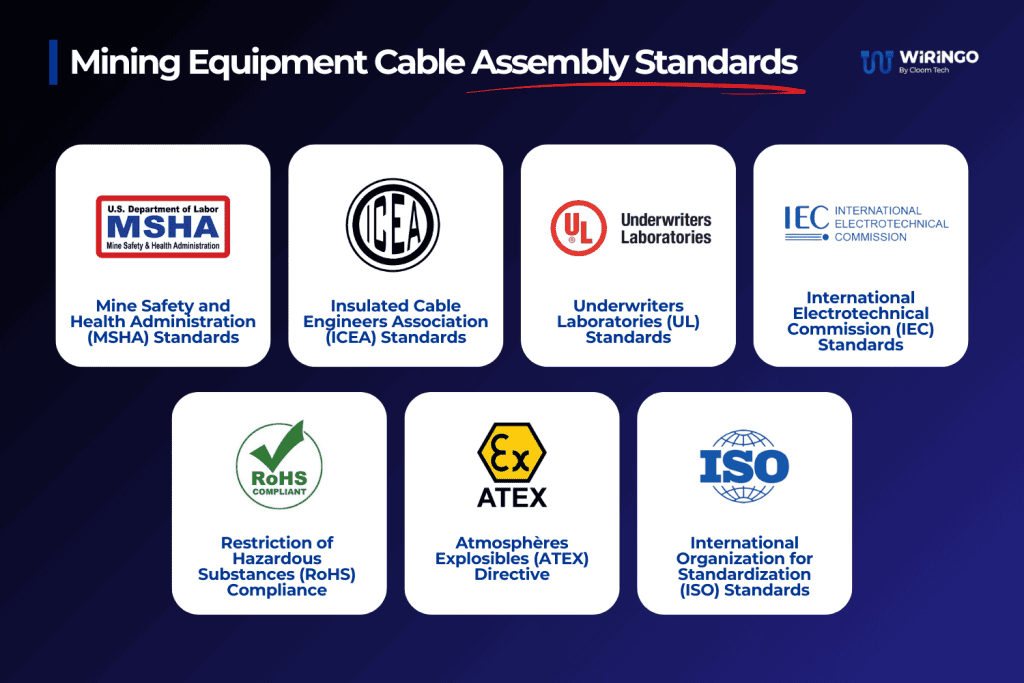
Mining Equipment Cable Assembly Standards
Mining cables must meet strict safety standards. These rules ensure cables perform safely in dangerous environments.
Following these standards protects workers, meets legal requirements, and ensures reliable operation, as well as post-operation and maintenance. Properly certified cables reduce risks and maintenance costs.
Mine Safety and Health Administration (MSHA) Standards
MSHA standards govern mining equipment in the United States. They cover flame resistance and smoke toxicity. All mining cables must meet these requirements for legal operation in U.S. mines.
Insulated Cable Engineers Association (ICEA) Standards
ICEA sets guidelines for cable design and testing. Their standard S-75-381 covers mining cables specifically. These rules ensure consistent quality across manufacturers.
Underwriters Laboratories (UL) Standards
UL develops safety standards for many industries. UL 1650 applies to portable power cables used in mining operations. UL certification means cables have passed rigorous safety testing.
International Electrotechnical Commission (IEC) Standards
IEC provides global standards for electrical equipment. IEC 60502 covers power cables with extruded insulation. These standards ensure international compatibility.
Restriction of Hazardous Substances (RoHS) Compliance
RoHS limits harmful substances in electrical equipment. Mining cables must comply with regulations to protect worker health and the environment. This prevents excessive lead, mercury, and other toxic materials.
Atmosphères Explosibles (ATEX) Directive
ATEX rules cover equipment used in explosive environments. Mining cables in these areas need special designs to prevent sparks and heat that could cause explosions.
International Organization for Standardization (ISO) Standards
ISO develops worldwide standards for many products. These ensure mining cables meet consistent quality requirements across different markets.
Choosing the Best Mining Equipment Cable Assembly Manufacturer
Wiringo specializes in custom cable assemblies and wire harness solutions for mining control and automation. We hold certifications for IATF 16949 and ISO 9001. Our high-quality products meet your exact needs with superior reliability.
Our rugged cable assemblies for mining offer:
- Exceptional durability to withstand extreme conditions
- Custom designs for your specific motor and pump requirements
- Thorough testing for CE compliance and quality checks
- Full compliance with all safety standards
- Expert technical support for installation
- Competitive pricing
- On-time delivery
Want to improve the reliability of your mining operation? Contact Wiringo today and get a free quote on complex cable assemblies built to your specifications.
Get Your Free Sample!
Explore our custom services now. Email us at [email protected] for more details.