


Cable assemblies often operate in harsh environments where moisture, vibration, chemicals, and temperature extremes can degrade their performance over time. To strengthen the assembly and protect sensitive connectors, inserts, substrates, and conductors, manufacturers rely on three proven methods: overmolding, potting, and braided sleeving. These techniques use different molding methods, resin systems, and protective materials to reinforce the assembly and extend service life.
Selecting the right protection method is a key part of the broader design and manufacturing process. Techniques such as overmolding and insert molding, full encapsulation, and braided protection each offer different levels of sealing strength, abrasion resistance, and flexibility. Understanding these differences helps engineering and purchasing teams match the right method to environmental demands and long-term durability needs.
This article provides a comprehensive guide to overmolding, potting, and braided sleeving for cable assemblies and wire harnesses. It explains how each process works, outlines common overmolding materials, compares methods such as two-shot molding and resin potting, and describes how braided sleeving protects assemblies without restricting flexibility.
By the end, you will be equipped to select the appropriate solution for your final product, whether the application requires molded strain relief, full encapsulation, or flexible abrasion protection.
Get Your Free Sample!
Explore our custom services now. Email us at [email protected] for more details.
Why Cable Protection Matters
Cable assemblies undergo mechanical stress, bending, pull forces, and abrasion that can weaken insulation, damage conductors, and introduce reliability issues. Without the right protection, moisture, chemicals, corrosion, and vibration can lead to short circuits, signal loss, or complete assembly failure.
Methods such as overmolding, potting, and braided sleeving help stabilize the substrate and maintain the integrity of the assembly. By selecting the right protection method early in the development process, engineers strengthen the final product, reduce maintenance requirements, and improve durability across a wide range of environments.
What Is Overmolding?
Overmolding is a specialized molding process used to protect cable terminations, connectors and internal components. It does so by forming a durable layer of material directly over the assembly. The process uses injection molding machines to inject molten material, often PVC, TPU, TPE, silicone, or another thermoplastic, over a connector or cable junction.
It’s one of the most widely used cable protection techniques because it creates a bonded seal that supports long-term performance. During molding, the material flows into the mold cavity, forming around the connector, substrate, or insert to create a single, seamless outer layer.
Advantages of Overmolding
Overmolding provides durability, stability, and improved handling for cable assemblies by forming a molded seal around the connector or termination. This method strengthens the assembly while allowing manufacturers to shape functional and ergonomic features.
Better Strain Relief
The overmolding process reinforces the transition between the cable and connector, creating dependable strain relief that protects internal conductors. By molding material around the substrate or insert, overmolding reduces pull stress and prevents premature failure at high-stress points.
Moisture and Chemical Resistance
Because molten thermoplastic, TPU, or silicone forms a uniform seal, overmolding enhances moisture protection and shields the assembly from chemicals, oils and environmental contamination. This protection is valuable in industrial, automotive, and outdoor applications.
Enhanced Appearance and Ergonomics
Overmolding allows manufacturers to form ergonomic grips, smooth contours and branded housings. It’s possible to build color-coding, logos, and molded identifiers directly into the design, improving usability and visual consistency across multiple cable assemblies.
Flexible Material and Design Options
Overmolding provides a wide range of materials and shapes. Engineers can select the best molding material for durability, abrasion resistance or flexibility. Because molding allows complex geometry, overmolding also supports greater design flexibility for connectors and custom housings.
Ideal Applications For Overmolding
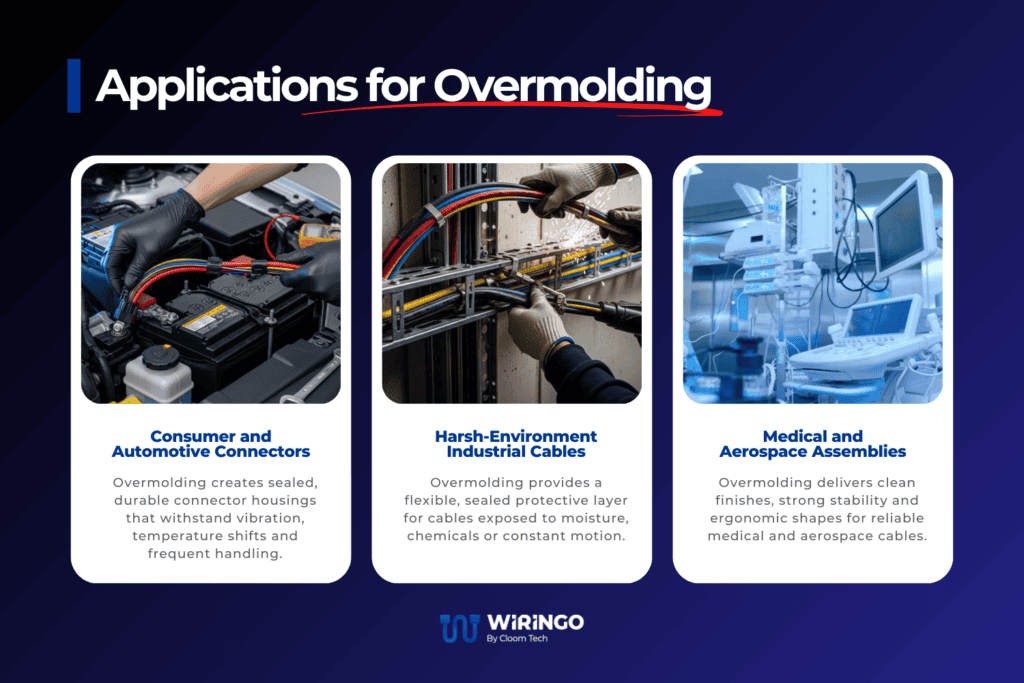
Overmolding applications include:
- Consumer and Automotive Connectors: Overmolding is used to create sealed, durable housings for connectors in consumer electronics and automotive systems. Vibration, temperature changes, and frequent handling require a molded protective layer.
- Harsh-Environment Industrial Cables: Industrial cables exposed to moisture, chemicals or continuous movement benefit from overmolding. It creates a single protective seal that maintains flexibility and long-term performance.
- Medical and Aerospace Assemblies: Medical and aerospace cables use overmolding to achieve a clean, professional finish with strong mechanical stability. The method supports complex shapes, smooth surfaces, and ergonomic handling with consistent reliability.
What is Potting?
Potting is a manufacturing process used to encapsulate cable junctions or electronic components in a liquid resin that hardens into a solid protective layer. During potting, a liquid compound (epoxy, polyurethane or silicone) is poured into a housing or cavity surrounding the cable termination. As the resin cures, it forms a rigid barrier that locks components in place.
Unlike overmolding, which forms an outer shell, potting fills internal gaps to create complete environmental sealing around the assembly. This process stabilizes connectors, sensors, and wiring by preventing movement, vibration fatigue, and moisture exposure.
Advantages of Potting
Potting offers one of the strongest forms of environmental and mechanical protection available for cable assemblies. Here are some advantages:
Superior Environmental Sealing
Potting compounds form a rigid encapsulation that blocks moisture, dust, chemicals, and corrosion. It’s stronger than standard sealing, making potting ideal for assemblies exposed to outdoor conditions, liquids, or contaminants.
Electrical Insulation and Short-Circuit Prevention
Because the resin fills all internal gaps, potting prevents conductive paths from forming between terminals, wires, or components. This minimizes the risk of short circuits and provides stable insulation properties throughout the life of the assembly.
Excellent Vibration and Impact Resistance
The cured material holds components firmly in place, reducing flexing, wire fatigue, and mechanical stress during operation. This stability makes potting especially effective in rugged or mobile equipment where continuous vibration can compromise performance.
Permanent, Maintenance-Free Protection
Potting is a permanent solution. Once the compound cures, the assembly can’t be disassembled without damage. It’s ideal for applications that require long-term protection, tamper resistance, or maximum durability in the final product.
Ideal Applications for Potting
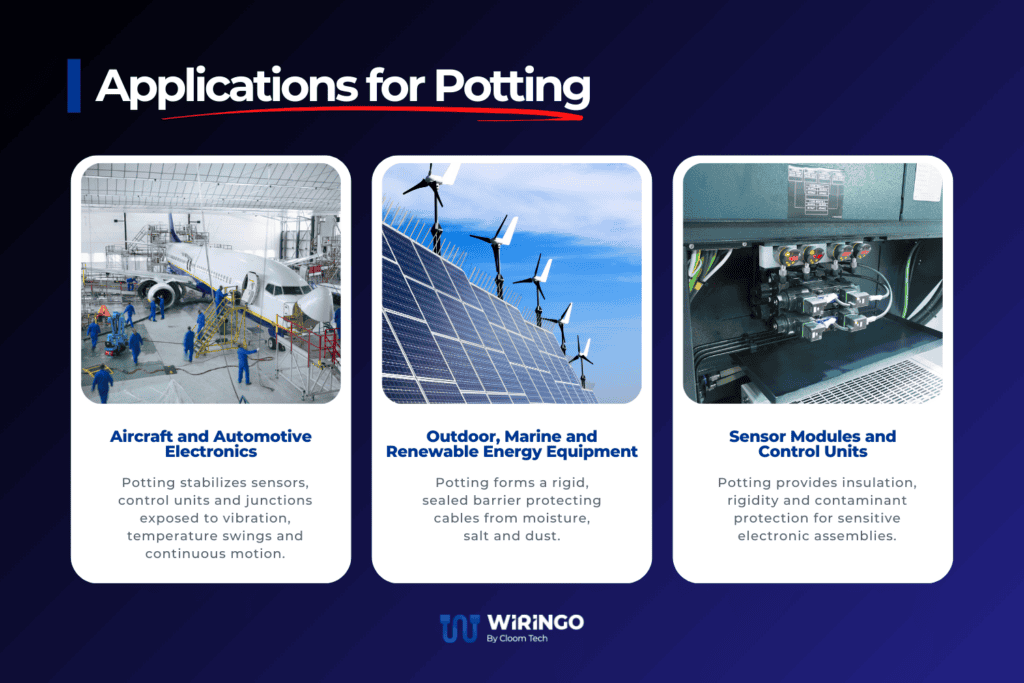
Potting is best used in:
- Aircraft and Automotive Electronics: Potting is often used in systems exposed to vibration, temperature swings and continuous motion. It helps stabilize components such as sensors, control units and connector junctions.
- Outdoor, Marine and Renewable Energy Equipment: The rigid, sealed barrier protects cable assemblies in harsh outdoor environments where moisture, salt, or dust can damage internal wiring.
- Sensor Modules and Control Units: Potting creates long-term mechanical stability for assemblies that house sensitive electronics, making it ideal for modules requiring insulation, rigidity, and protection from contaminants.
Get Your Free Sample!
Explore our custom services now. Email us at [email protected] for more details.
What is Braided Sleeving?
Braided sleeving is a flexible, woven protective layer used to cover cable assemblies, wire bundles and harnesses. Made from PET, nylon or stainless steel wire, braided sleeving expands to slide over cables and then contracts to hold them securely. Because it conforms to different shapes, it supports clean routing, wire bundling and easy installation across a range of assemblies.
It provides abrasion resistance, organization, and mechanical stability without permanently altering the assembly. These abilities make it a practical alternative to overmolding or potting when flexibility and serviceability are priorities.
Advantages of Braided Sleeving
Braided sleeving provides flexible, non-permanent protection for cable assemblies, allowing wires to move freely. At the same time, they’re still shielded from abrasion, heat, and mechanical wear.
Abrasion and Wear Resistance
The woven structure safeguards cables from friction, rubbing, and sharp edges. It’s ideal for dynamic or high-friction environments where constant movement could damage insulation or conductors.
Heat Dissipation and Ventilation
Unlike sealed molding or potting methods, braided sleeving allows for airflow around the assembly. This prevents heat buildup, supports thermal stability and helps maintain performance in equipment with continuous electrical loads.
Easy Installation and Maintenance
Braided sleeving slides over wires and connectors quickly and can be removed just as easily. This makes it a preferred option for harnesses that require periodic maintenance, rework, inspection or upgrades.
Optional EMI/RFI Shielding
Braided sleeving made from conductive materials like metallized fibers or stainless steel wire provides effective electromagnetic interference and radio-frequency interference shielding. This EMI and RFI protection improves signal integrity in sensitive cables and electronics.
Ideal Applications for Braided Sleeving
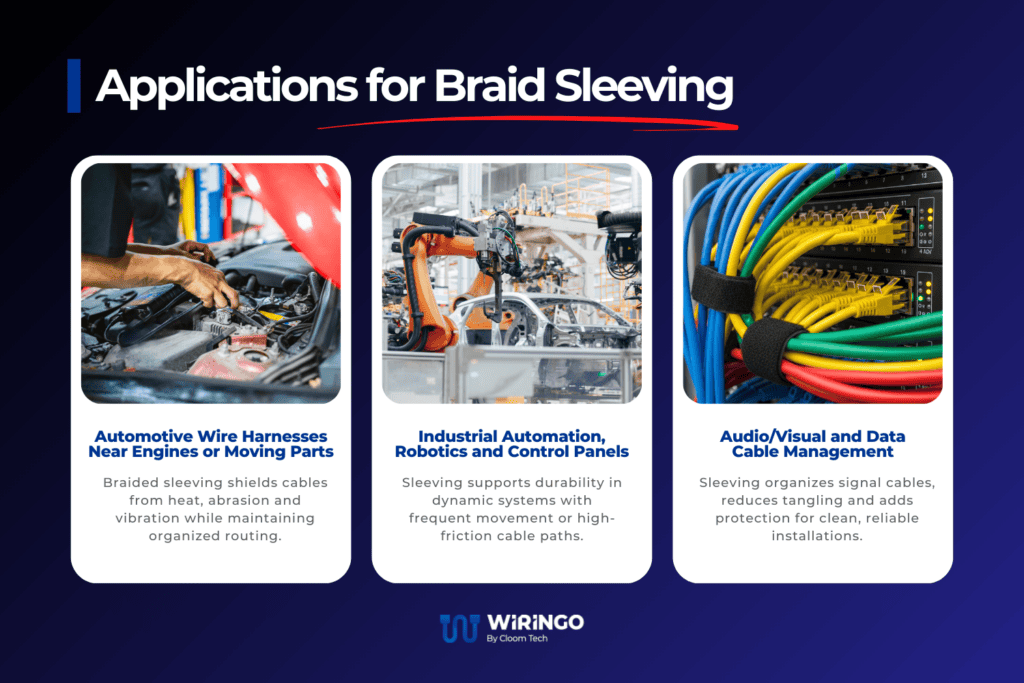
- Automotive Wire Harnesses Near Engines or Moving Components: Braided sleeving protects automotive wire and cable bundles from heat, abrasion and vibration while keeping routing organized in tight spaces.
- Industrial Automation, Robotics and Control Panels: In dynamic systems where wires move constantly or pass through high-friction paths, sleeving supports durability without restricting flexibility.
- Audio/Visual and Data Cable Management: Sleeving provides neat organization, reduced tangling and added protection for signal cables, supporting clean installations and long-term reliability.
Overmolding Vs. Potting vs. Braided Sleeving: Key Differences
Each protection method offers its own balance of sealing strength, flexibility, environmental resistance and long-term serviceability.
| Feature | Overmolding | Potting | Braided Sleeving |
| Protection Type | Molded strain relief and moisture barrier created through the overmolding process | Full encapsulation using resin for complete insulation | Physical abrasion protection for wire bundles and cable assemblies |
| Flexibility | Moderate flexibility depending on molding material (TPU, TPE, silicone, thermoplastic) | Rigid after curing; no movement of internal components unless semi-flexible | High flexibility with woven PET, nylon, or stainless steel wire |
| Environmental Resistance | Excellent moisture, chemical and vibration resistance | Good sealing against liquids, dust, impact and extreme temperatures | Moderate to high, depending on sleeving material |
| Reparability | Difficult to repair once overmolded | Not repairable; potting is permanent | Easy to remove, replace or rework |
| Aesthetics | Highly customizable; supports ergonomic shapes, color coding and branding | Not visible once cured inside the housing | Moderate; provides clean bundling and organized routing |
| Cost | Medium, factoring in mold and tooling design | Higher due to material cost and curing process | Lower; materials and installation are cost-effective |
| Best for | Sealed connectors, outdoor assemblies, cable strain relief | Electronics and junctions in harsh or high-stress conditions | Wire bundling, abrasion-heavy uses and flexible routing paths |
How To Choose The Best Cable Protection Method
Selecting between overmolding, potting, and braided sleeving comes down to the environment, service requirements and performance goals of the cable assembly. Each method offers different levels of sealing, flexibility and maintainability, so choosing the right option depends on the application.
Environmental Conditions
Moisture, vibration, chemicals, and extreme temperatures often determine which protection method performs best. Potting provides the strongest environmental barrier. Overmolding offers excellent sealing with added strain relief and braided sleeving suits internal harness routing where abrasion protection is a priority.
Serviceability Needs
Potting is a permanent solution and cannot be reversed once cured. Overmolding is semi-permanent, difficult to remove, but still more manageable than potting. Braided sleeving is the most serviceable option because it can be removed or replaced without damaging the assembly.
Cost and Production Goals
Overmolding and potting require tooling, molds, materials and setup time, making them better suited for medium- to high-volume projects. Sleeving provides a lower-cost, scalable alternative for teams that need fast turnaround, minimal tooling or flexible batch sizes.
Industry Standards and Compliance
Applications in automotive, aerospace, medical or industrial systems may require alignment with ISO 9001, IATF 16949 or RoHS standards. Custom molding methods, potting compounds or sleeving materials should meet the relevant quality, safety, and compliance requirements.
Custom Overmolding, Potting, And Sleeving Solutions
Wiringo provides engineered protection solutions for cable assemblies using overmolding, potting and braided sleeving. Our cable assemblies support a wide range of industries with durable, high-performance results.
- Complete Protection Options For Any Application: Wiringo provides overmolding, potting, and braided sleeving solutions within a single manufacturing environment. This allows teams to choose the right method for their cable assemblies based on environmental, mechanical, and serviceability needs.
- Certified Under ISO 9001 and IATF 16949 for Quality And Reliability: Our certified quality management systems support consistent production, traceability, and dependable performance across every assembly and protection method we deliver.
- Uses Advanced Production Methods And Testing: Wiringo employs ultrasonic welding, automated QA, environmental testing, and controlled manufacturing processes to validate durability, safety, and long-term performance for every custom assembly.
Contact Wiringo today to discuss your cable protection needs and determine whether overmolding, potting, or braided sleeving is the best option for your next custom assembly project.
FAQs
Which cable protection method offers the best environmental resistance?
Potting provides the highest level of environmental sealing. The resin fully encapsulates the assembly, leaving no air gaps and forming a permanent barrier. Materials for overmolding, such as TPU, TPE, or silicone, also offer excellent protection. Braided sleeving provides moderate protection and works well for abrasion-heavy or flexible routing paths.
Is braided sleeving a good alternative to overmolding for flexible cable assemblies?
Ye, braided sleeving is often chosen when flexibility, ventilation, and serviceability are priorities. While it doesn’t match the sealing performance of overmolding vs potting, it excels in dynamic environments where cables move frequently or require ongoing access. It’s also easy to remove or replace, unlike rigid encapsulation methods.
What’s the difference between insert molding and overmolding?
Insert molding molds plastic around a pre-existing component placed inside the mold before material is injected. Overmolding adds a second molded layer over an already finished part or cable assembly. This creates an outer protective jacket for strain relief, sealing, or ergonomic shaping. Insert molding embeds a component inside the mold, while overmolding adds a molded layer on top of an existing structure.
Can braided sleeving provide electromagnetic interference (EMI) protection?
Yes, when braided from conductive fibers or stainless steel wire, sleeving can function as an EMI/RFI shield. While this isn’t a full replacement for molded or potted shielding, it offers effective signal protection for many assemblies and simplifies installation.
Get Your Free Sample!
Explore our custom services now. Email us at [email protected] for more details.