


Choosing between custom and off-the-shelf wire harnesses is an important decision for manufacturers in automotive, industrial, aerospace, and other technical sectors. A well-designed wire harness supports dependable electrical communication, organizes wires and connectors, and helps equipment operate safely across a wide range of environments.
Should you choose a custom or off-the-shelf wire harness for your needs? Off-the-shelf harnesses offer fast availability and fixed specifications, while a custom wire harness is built for equipment that requires unique layouts, specialized connectors, or operation in demanding conditions.
Understanding the differences between custom and off-the-shelf wire harnesses helps teams match the right harness to the application, project timeline, and performance goals. Here’s a guide to the advantages and limitations of each, and Wiringo supports OEMs with reliable wire harness solutions.
Get Your Free Sample!
Explore our custom services now. Email us at sales@wiringo.com for more details.
What Are Off-The-Shelf Wire Harnesses And When Should You Use Them?
Off-the-shelf wire harnesses are pre-engineered, mass-produced assemblies built with fixed specifications, standardized wires, and common connector types. Because they follow established layouts and electrical ratings, they’re widely used in applications where the wiring requirements are predictable and unchanged from one unit to the next.
These off-the-shelf options are usually chosen for equipment that follows standard wiring diagrams or factory wiring layouts, offering quick availability and dependable performance without any engineering work. They’re best suited for projects that don’t require unique routing, custom wiring, or specialized environmental protection.
Benefits Of Off-the-Shelf Wire Harnesses For High-Volume Production
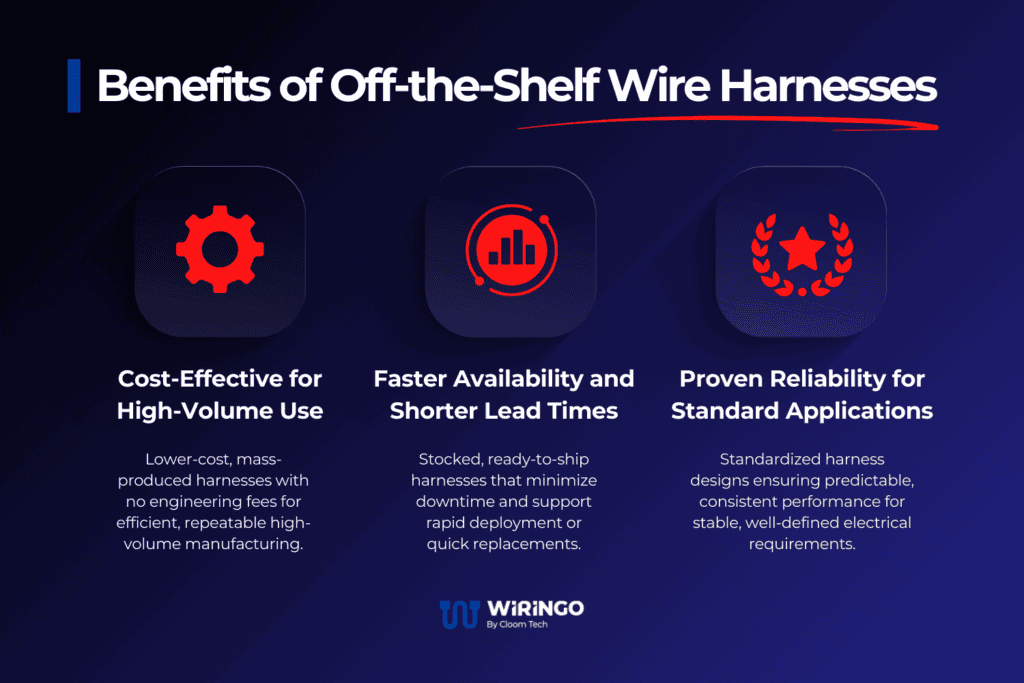
What are the Benefits Of Off-the-Shelf Wire Harnesses For High-Volume Production
Off-the-shelf wire harnesses offer practical advantages for projects built around standard electrical requirements. When production volumes are high, and design flexibility is not needed, these ready-made harness assemblies help manufacturers control costs, shorten delivery timelines, and maintain predictable performance.
Cost-Effective for High-Volume Use
Because off-the-shelf wire harnesses are produced in large quantities, their unit cost is lower than custom-built alternatives. With no engineering or development fees, they offer an economical option for manufacturers focused on repeatable, high-volume output.
Faster Availability and Shorter Lead Times
Standard harness assemblies are stocked and ready for immediate shipment, reducing downtime and keeping production lines moving. This makes them ideal for teams that need rapid deployment or quick replacement without waiting for design or fabrication.
Proven Reliability for Standard Applications
Off-the-shelf harnesses follow established specifications and widely used wiring layouts, delivering predictable performance for applications with stable electrical requirements. Their consistent construction provides dependable results for systems designed around standard configurations.
Limitations Of Off-The-Shelf Wire Harnesses In Specialized Applications
While off-the-shelf wire harnesses are practical for standard systems, they can fall short when equipment requires unique layouts, specialized connectors or operation in environments that demand more than a fixed configuration can offer.
Limited Customization
Because off-the-shelf harnesses are built with predetermined wires, connectors and routing paths, they offer little flexibility for projects with unusual layouts or specialized electrical requirements. A standard stock harness may include components that are unnecessary or lack the exact features needed for the application.
Fit and Compatibility Issues
Standard harnesses rarely match the exact geometry of custom machinery or advanced equipment. Differences in mounting points, enclosure size or equipment layout can lead to awkward routing, excess wire length or cluttered installations that may affect performance or servicing.
Potential Over- or Under-Engineering
An off-the-shelf harness may deliver more functionality than needed, wasting space and adding cost, or it may not provide enough capability to meet the system’s electrical demands. In either case, performance or efficiency can suffer when the harness doesn’t match the equipment’s true design requirements.
Get Your Free Sample!
Explore our custom services now. Email us at sales@wiringo.com for more details.
What Are Custom Wire Harnesses And Why Do They Matter For Complex Systems

What are the Benefits Of Custom Wire Harnesses For Precision And Performance
Custom wire harnesses are engineered for applications where standard layouts and fixed specifications can’t meet performance or installation requirements. These purpose-built harness assemblies follow a design process that accounts for electrical needs, routing constraints, and environmental demands across a wide range of industries.
Purpose-Built for Precise Specifications
A custom wire harness is developed to match the exact electrical ratings, connector types, wire gauges, and routing paths required by a system. Instead of relying on a fixed, pre-made structure, custom harness design accommodates the number of wires, terminal types, insulation materials, and harness bundles needed for optimal fit and function.
Engineered From Concept Through Production
Custom harnesses are developed through a complete design-and-build process that may include drawings, wiring diagrams, prototyping, testing, and refinement. Engineers evaluate conductor selection, insulation, crimp requirements, connector interfaces, and environmental conditions to produce a well-designed harness that accurately supports a system’s electrical components.
Built for Demanding Applications
Custom harnesses are used in environments where specialized routing, compact layouts, or extreme conditions make standard harness assemblies unsuitable. Whether supporting engine control units, industrial machinery, automation systems, or sensitive electronics, a custom harness is one of the most reliable ways to meet strict performance, durability, and compliance requirements.
Benefits Of Custom Wire Harnesses
When a system requires unique layouts, specialized connectors, or operation in demanding conditions, custom wire harnesses offer performance and compatibility advantages that off-the-shelf options can’t match. These harness assemblies are engineered around the application itself, giving manufacturers more control over routing, materials, and long-term reliability.
Tailored Performance and Compatibility
A custom harness is designed to fit the exact layout of the equipment, supporting precise routing, specific connector types, and the required number of wires. This allows the harness to fit into tight spaces, handle unusual geometries, and accommodate complex sensor and terminal arrangements while maintaining consistent power and signal flow.
Enhanced Durability and Reliability
Because engineers choose materials such as insulation, shielding, and conductor types for the expected conditions, custom harnesses are built to withstand vibration, heat, moisture, and EMI. High-quality construction reduces maintenance needs and improves long-term performance, making these harness assemblies suitable for extreme conditions and continuous operation.
Flexibility in Design and Materials
Custom solutions allow engineers to specify insulation compounds, shielding methods, connectors and bundle layouts that match the functional requirements of the system. This flexibility supports specialized equipment, sensitive electronics, automotive machinery and environments where different wire types or custom components are needed.
Compliance With Industry Standards
Custom harnesses can be manufactured to meet required certifications such as IATF 16949, ISO 9001 or RoHS, important for sectors like automotive, aerospace, medical, and industrial automation. This makes them suitable for OEMs that require documented traceability, quality standards and consistent manufacturing practices.
Limitations Of Custom Wire Harness Design
While custom wire harnesses offer performance and compatibility advantages, they also require more development time, engineering involvement, and upfront planning. Understanding these considerations helps determine whether a custom solution aligns with the project’s goals and constraints.
Higher Initial Cost
Custom harnesses involve engineering design, prototyping, specialized materials, and testing, which increases the initial investment. These costs reflect the work required to design and build a harness to exact specifications, especially when they require unique connectors, insulation, or bundle layouts.
Longer Lead Times
Because custom wiring involves concept development, drawings, prototype validation, and refinement, production timelines are longer than off-the-shelf options. This extended schedule includes the assembly process, quality checks, and any adjustments needed to finalize the design.
Requires Technical Collaboration
Successful custom wiring solutions depend on clear communication between the engineering team and the harness manufacturer. Detailed inputs, such as wiring diagrams, routing constraints, electrical ratings, and connector types, help produce a harness that fits the system accurately. Collaboration is especially important for complex equipment with multiple sensors, electrical components, or non-standard layouts.
What To Consider When Choosing Between Custom And Off-The-Shelf Wire Harnesses
Selecting custom vs off-the-shelf wire harnesses comes down to understanding the functional needs of the system, project timelines, and long-term performance expectations. Evaluating a few core factors helps determine which harness option aligns best with your equipment and manufacturing goals.
Application Requirements
Projects that involve unusual routing paths, specialized connector types, tight spaces or exposure to heat and moisture often require a custom wire harness. Standard wiring layouts with common cables and wires may be compatible with a stock harness, but equipment with unique electrical ratings or sensor configurations most likely needs a harness built to specific specifications.
Production Volume
For high-volume, repeatable manufacturing, off-the-shelf solutions offer predictable pricing and fast procurement. Low- or mid-volume projects with specialized layouts or varied equipment configurations benefit more from custom harnesses, since the harness may need to match different components or a unique assembly and wire harness structure.
Lead Time and Budget
If immediate availability is necessary, an off-the-shelf harness is usually the fastest choice. When performance, routing or connector alignment matters more than speed, custom wiring delivers better long-term value. Budget planning should weigh the higher upfront investment of custom work against the efficiency and performance gains of a well-designed harness.
Compliance and Quality Standards
Industries such as automotive, aerospace, and industrial machinery often require certified, traceable harness assemblies, which are achieved through custom wire harness manufacturing. When regulatory expectations, OEM requirements, or quality standards matter, custom harnesses offer better alignment with certifications like IATF 16949, ISO 9001, and RoHS.
Wiringo Provides Custom And Off-The-Shelf Wire Harness Solutions
Wiringo supports manufacturers across automotive, industrial, medical, and aerospace sectors with custom wire harness solutions. As a wire harness manufacturer certified to ISO 9001 and IATF 16949, we deliver consistent quality across every harness assembly, cable harness, and integrated wiring solution.
- ISO 9001 and IATF 16949 Certified: Wiringo follows strict quality management standards for every wire harness, cable harness, and assembly we produce.
- Full-Service Manufacturing: We offer complete capabilities, including custom wire harness design, prototyping, routing support, and high-volume production.
- Advanced Production Technologies: Our processes include ultrasonic welding, overmolding, automated inspection, crimping, tinning, and precision cable and wire harness fabrication.
- Experience Across Automotive, Industrial, Medical, and Aerospace: Wiringo has a proven track record delivering harness assemblies and wire harness solutions that match OEM specifications and detailed wiring diagrams.
- Flexible Support for Custom and Off-The-Shelf Options: Whether you need a fast-deployment stock harness or a custom one, we provide reliable performance, consistent quality, and a customer-first approach.
Contact Wiringo today to request a quote or discuss how our team can support your next wire harness assembly project.
FAQs
How do I know if my application needs a custom wire harness?
A system needs a custom wire harness when the equipment layout, connector types, wire gauge requirements or environmental conditions fall outside the limits of a stock harness. If the harness must fit a tight space, handle specific routing paths, support unique sensors or operate reliably in heat and moisture, a custom design provides the precision and performance the application requires.
Are off-the-shelf wire harnesses suitable for industrial or automotive use?
Yes, off-the-shelf wire harnesses can work well in automotive or industrial machinery when the wiring layout and electrical ratings match standard configurations. These harnesses are usually installed in repeatable builds where the harness bundles and connectors already align with factory wiring. When specialized equipment or non-standard connectors are involved, a custom harness is often the better option.
What factors affect the cost of a custom wire harness?
Costs depend on the number of wires, connector types, crimp requirements, insulation materials, bundle complexity and whether prototypes or testing stages are needed. More complex harness assemblies, tight routing or specialized materials can increase upfront investment, but they also improve long-term efficiency and performance.
How do lead time and production volume impact the choice between custom and off-the-shelf harnesses?
High-volume, repeatable projects usually benefit from the fast availability of off-the-shelf options, while custom wiring is better suited for lower-volume or specialized builds where performance matters more than immediate delivery. Larger production runs may justify the upfront engineering time for custom wiring, especially when the harness must fit specific routing or electrical requirements.
Get Your Free Sample!
Explore our custom services now. Email us at sales@wiringo.com for more details.